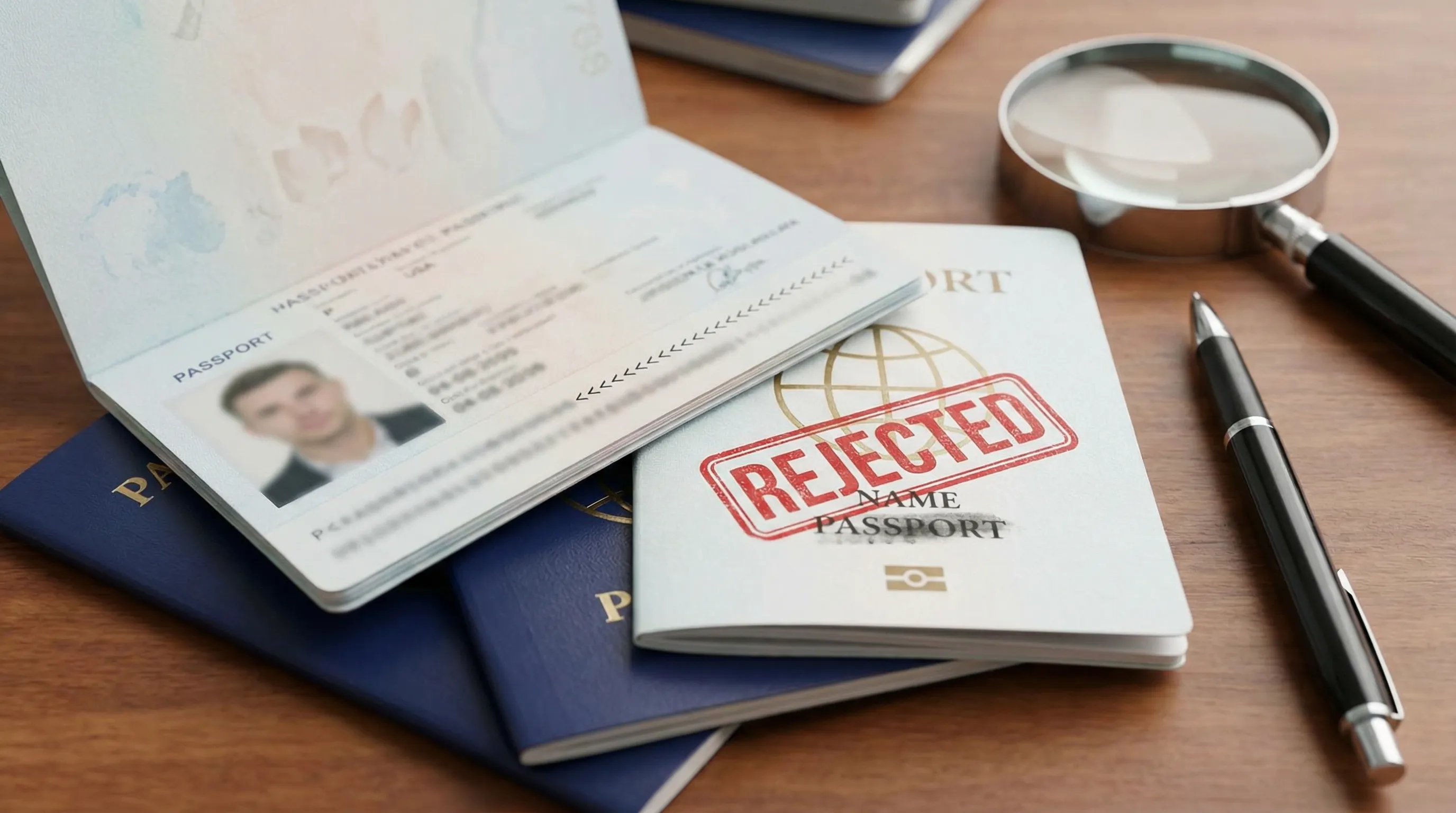
The passport application mistakes that cause the most trouble are not exotic. They are the boring ones the U.S. Department of State sees every day: the wrong form, a DS-11 signed too early, the wrong birth certificate copy, a photo with shadows, or a fee problem that puts the file on hold.
As of March 22, 2026, the State Department lists routine processing at 4 to 6 weeks and expedited processing at 2 to 3 weeks, but that still excludes mailing time. The same page says each mailing leg can add up to 2 weeks. In practice, one preventable mistake can turn a normal application into a missed-trip problem very quickly.
If your case is already on the renewal path rather than a first passport or correction path, the U.S. renewal guide is the better companion page for choosing between mail, online, and urgent-service options.
Key Takeaways
- Bad photos are the number one reason the State Department puts passport applications on hold, so photo quality is not a minor detail.
- Using the wrong form is still one of the cleanest ways to lose time. DS-11 in-person applications must be completed but not signed until the acceptance agent tells you to sign.
- Citizenship evidence must be the right kind of document, not just a document with the right story. Informational birth records and missing photocopies cause avoidable delays.
- Fee mistakes are still common because first-time adult applications usually involve two separate payments: the application fee to the U.S. Department of State and the execution fee to the acceptance facility.
- If the State Department sends you a letter asking for more information, you generally have 90 days to respond.
- If you are applying outside the United States, use this article as a checklist framework only. The exact form, photo, document, and payment rules come from your own issuing authority.
| Mistake | What Usually Happens | Fast Fix | Why It Matters |
|---|---|---|---|
| Using the wrong form | Your application gets delayed, returned, or redirected | Use the State Department form finder before you print anything | DS-11, DS-82, DS-64, and DS-5504 solve different problems |
| Signing DS-11 too early | The acceptance facility cannot take it as submitted | Bring DS-11 completed but unsigned | This is a real counter-day failure mode, not a theoretical rule |
| Wrong birth certificate copy | You get asked for better citizenship evidence | Use an original or certified copy with the issuing office seal | "Looks official" is not the same as acceptable evidence |
| Missing photocopies | Your file slows down or the appointment goes sideways | Bring single-sided copies of citizenship evidence and ID | The State Department explicitly says missing copies can add time |
| Bad passport photo | Your application is put on hold | Use a recent 2 x 2 photo with a plain white or off-white background | Photo holds are common and expensive in lost time |
| Wrong fee or payee | Your application cannot move cleanly through intake | Check the current fee page and payment instructions the same day you apply | First-time applicants often forget the separate execution fee |
| Applying too late | You miss your travel window even if the passport is eventually approved | Plan around processing time plus mailing time, not headline processing time alone | The official processing estimate does not include the full door-to-door timeline |
Which passport application mistakes matter most right now?
The biggest mistakes are the ones that trigger a hold after you think you are finished. That is why photo errors, document problems, wrong-form issues, and payment mistakes matter more than cosmetic formatting problems.
The official State Department pages are unusually clear on this point. The photo page says bad photos are the number one reason applications get put on hold. The response-letter page adds a second overlooked detail: if the Department contacts you for missing information, you usually need to respond within 90 days or the application can stall out completely.
That combination is what makes this topic worth handling as operations, not as generic travel advice. A passport application is less like filling out a simple form and more like passing a checklist at intake. Miss one required item and the whole queue stops moving.
Are you using the wrong form, or signing the right form at the wrong time?
This is the cleanest mistake to prevent. If you do not qualify for renewal, you need DS-11. If you do qualify for renewal, you usually need DS-82. If your passport was lost or stolen, DS-64 may be involved. If you are correcting a recent issuance error or a qualifying name change, DS-5504 may be the right path.
The State Department's form finder is also explicit about a detail many applicants miss: DS-11 must be completed but not signed before your in-person appointment. If you sign it early at home, the acceptance agent cannot treat it as a properly witnessed in-person application. That is a real same-day failure mode that generic passport roundup posts rarely mention.
Three practical rules reduce most form mistakes:
- Use the official form finder at
travel.state.govon the day you apply. - Print or download the current form version from the official site only.
- For DS-11, fill it out in advance but wait to sign until instructed at the appointment.
If you are not sure whether you qualify for DS-82 renewal, default to checking the official eligibility flow instead of guessing from memory. People lose time here because they focus on "I had a passport before" rather than the actual eligibility rules.
If your real question is "Can I still renew instead of starting over?" read our US Passport Renewal Guide before you book an appointment or print the wrong packet.
Are your citizenship and identity documents the right kind, plus the right photocopies?
This is where otherwise careful applicants get tripped up. The State Department does not just want proof that you are telling the truth. It wants the specific class of evidence it accepts, in the specific submission format it requires.
For in-person applications, the citizenship-evidence page says to provide primary evidence of U.S. citizenship and a photocopy of the front and back if there is printed information. It also says photocopies must be clear, on white 8.5 x 11 paper, and single-sided. The same page warns that it may take longer to get your passport if you do not submit the document and a photocopy.
That means these are common failure modes:
- Bringing a hospital souvenir birth record instead of an original or certified birth certificate
- Bringing a document copy without the issuing office seal or stamp
- Forgetting the photocopy of the citizenship document
- Bringing ID but not a photocopy of the ID
- Printing copies double-sided because it seems more efficient
This is one of the easiest places to add real information gain over the current SERP. Many articles say "bring your birth certificate." They do not explain that the useful distinction is original or certified copy versus informational copy, or that the photocopy format itself matters.
If you are applying in person, treat your packet like this:
- Original or certified citizenship evidence
- One clean single-sided photocopy
- Government-issued photo ID
- One clean single-sided photocopy of that ID
That sounds fussy because it is. But it is still faster than rebuilding the packet after a bad appointment or a follow-up letter.
Will your passport photo get your application put on hold?
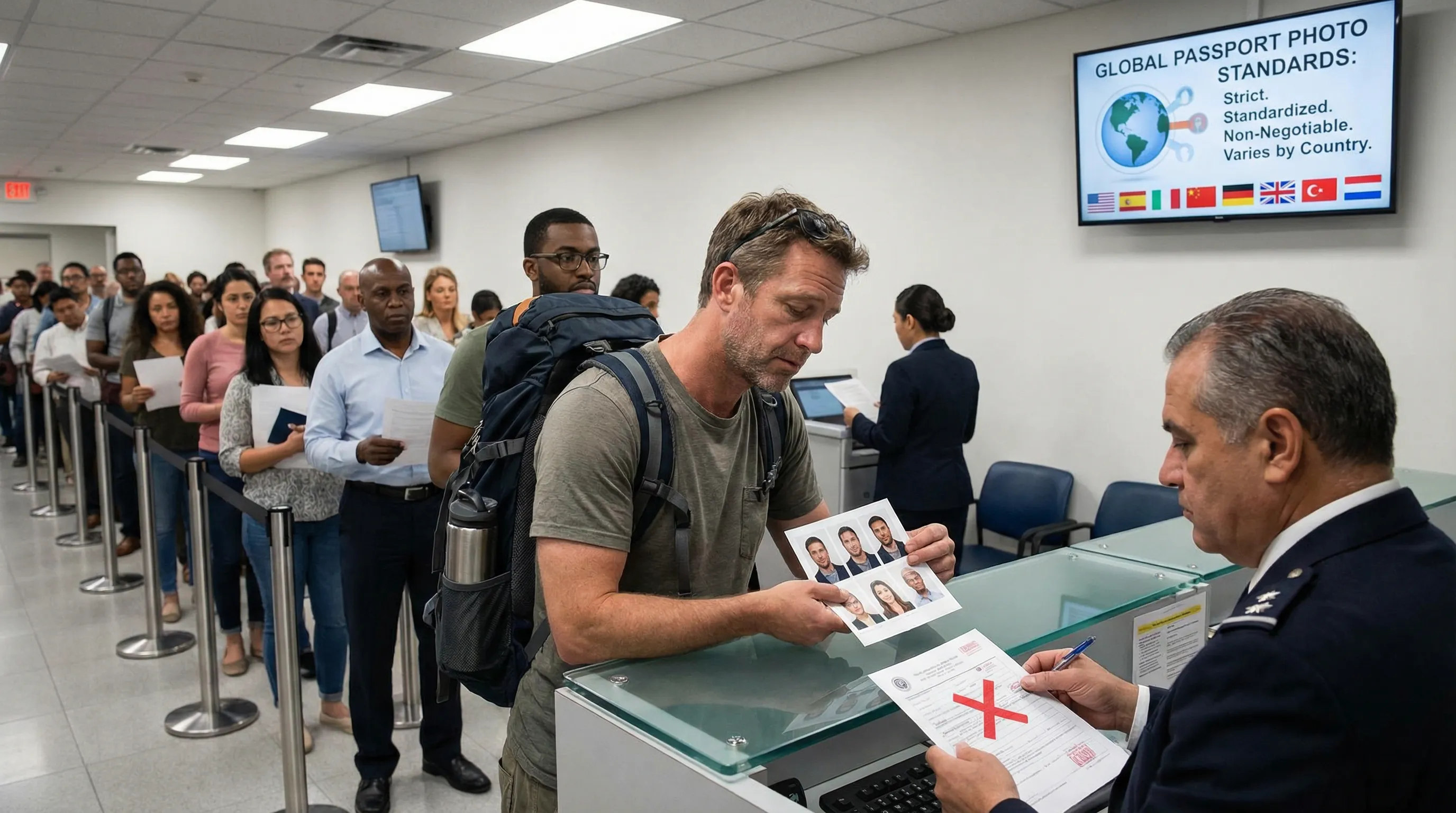
Very possibly. The State Department says bad photos are the number one reason passport applications get put on hold, which makes the photo the highest-value checkpoint in the whole process.
The current U.S. passport photo page says paper-form applicants should submit one color photo taken within the last 6 months, use a white or off-white background without shadows, remove eyeglasses, and avoid changing the image with computer software, phone apps, filters, or artificial intelligence. It also lists the correct size as 2 x 2 inches.
For applicants renewing online, the digital image requirements add another set of failure points: the image must be square, at least 600 x 600 pixels, no larger than 1200 x 1200 pixels, and 240 kB or less. That means a photo can look fine on your phone and still fail the upload rules.
The practical gotchas are predictable:
- Background looks white to you, but the image still has wall texture or shadow
- Face is centered badly or cropped too close
- Glasses create glare or violate the no-eyeglasses rule
- You used a touch-up app to "improve" lighting
- The digital file is too large, too small, or not square
This is also where the 90-day letter rule matters. On the State Department's response-letter page, bad photos are listed as the number one reason applications are put on hold, and applicants are told to respond within 90 days if contacted for a replacement photo. That is a concrete operational deadline, not a vague warning.
Are name, date, and Social Security details perfectly aligned across the whole packet?
These errors look small on screen and become expensive in processing. Your application, citizenship evidence, and identity documents need to tell the same story with the same names and the same key numbers.
The avoidable problems here are simple:
- Middle name included on one document and omitted on another
- Married name used on the form without the legal name-change document
- Date of birth typed incorrectly
- Social Security number entered incorrectly or left blank without a valid reason
- Old address or stale identifying information copied from a previous form
The reason this matters is not only clerical. Passport intake is built around matching fields across documents. If your packet creates an identity mismatch, the file stops being easy to process. That means manual review, a letter, or a restarted timeline.
Before you submit, do one boring but useful pass:
- Read your full legal name out loud from the application.
- Read it again from your citizenship evidence.
- Read it again from your ID.
- Compare your date of birth and Social Security number digit by digit, not by quick glance.
This is the kind of five-minute check that saves weeks.
Did you pay the wrong fee, or pay the right fee to the wrong place?
Fee mistakes are common because the payment logic is not intuitive to first-time applicants. A lot of people think "passport fee" is one number and one payment. It often is not.
The State Department fee guidance is clear that first-time adult DS-11 applications typically involve an application fee paid to the U.S. Department of State plus a separate execution fee paid to the acceptance facility. Expedited service is an additional charge. If you are using an agency or a special appointment path, the payment method rules can also change.
The gotcha is not just the amount. It is the structure:
- One payment may go to the U.S. Department of State
- A separate payment may go to the acceptance facility
- Expedited service is extra
- The accepted payment methods vary by where and how you apply
That is why "I brought enough money" is not a sufficient check. You need the right amount, the right split, and the right payment method for that exact application path.
If you want one rule here, use this one: check the official passport fee page on the same day you apply, not a screenshot, not a travel forum, and not an old checklist you saved last year.
Are you underestimating processing time, mailing time, or the 90-day response window?
This is the mistake that converts a correctable paperwork issue into a canceled trip. As of March 22, 2026, the State Department lists routine service at 4 to 6 weeks and expedited service at 2 to 3 weeks. It also says processing times do not include mailing time and that each mailing leg may take up to 2 weeks.
That means the real calendar is closer to this:
| Scenario | Official Processing | Mailing Reality | What You Should Assume |
|---|---|---|---|
| Routine | 4 to 6 weeks | Up to 2 weeks to arrive, plus up to 2 weeks to return | Think in door-to-door terms, not center-processing terms |
| Expedited | 2 to 3 weeks | Mailing still adds time unless you are on an agency path | Do not book a tight trip around the headline only |
| Application on hold | Timeline pauses | You may need to send more information | Respond immediately, because the letter workflow is time-sensitive |
The overlooked operational detail is the response deadline. The State Department's letter-response page says you must respond within 90 days. If your photo, form, or documents trigger a letter, waiting around because "the trip is still a few months away" is not a safe strategy.
If the passport is for a near-term trip, check the destination-side expiry rule too. Our passport validity checker helps you confirm whether the document will still meet entry rules by the time you travel.
The prove-it details most passport mistake articles skip
These are the official facts that make the difference between a useful guide and recycled SEO filler:
- The State Department says bad photos are the number one reason passport applications are put on hold.
- DS-11 applications for in-person service must be completed but not signed before the appointment.
- Citizenship evidence and ID both need photocopies, and the photocopies must be clear, single-sided, and on standard white 8.5 x 11 paper.
- As of March 22, 2026, routine processing is listed at 4 to 6 weeks and expedited at 2 to 3 weeks, but each mailing leg can add up to 2 weeks.
- If the Department contacts you for more information, you generally need to respond within 90 days.
Those are the details that actually change user behavior. They are also the details most generic passport articles either bury or miss entirely.
Official sources used in this guide
- U.S. Passport Photos, U.S. Department of State
- Respond to a Passport Letter or Email, U.S. Department of State
- U.S. Passport Form Wizard, U.S. Department of State
- Get Citizenship Evidence for a U.S. Passport, U.S. Department of State
- Get Photo ID for a U.S. Passport, U.S. Department of State
- Passport Fees, U.S. Department of State
- Processing Times, U.S. Department of State
When this advice is not enough
This guide is not enough for every case. If any of the situations below applies to you, stop treating your application like a standard first-time or renewal packet:
- Your passport was lost, stolen, badly damaged, or issued with limited validity
- Your citizenship evidence is unusual, missing, or inconsistent
- You are applying from outside the United States
- You need urgent travel service in less than a few weeks
- You are dealing with a major name, identity, or government-issued data correction
This is the honest "not for you" block most competitors avoid. If your case is messy, speed comes from using the exact official process for that edge case, not from hoping a generic checklist covers it.
Conclusion
Most passport application delays come from a short list of repeat mistakes: wrong form, early signature, bad photo, weak document packet, fee confusion, or unrealistic timing. None of those are glamorous problems, but they are the ones that keep showing up in the official guidance.
If you want the simplest working plan, do this: use the State Department form finder, build a packet with originals or certified copies plus clean photocopies, treat the photo like a compliance task, verify the fee page the day you apply, and build your timeline around door-to-door reality, not just the processing headline. Once the passport is issued, the next common mistake is confusing border-access labels, so our visa-free vs visa on arrival vs eTA guide is the useful next read.