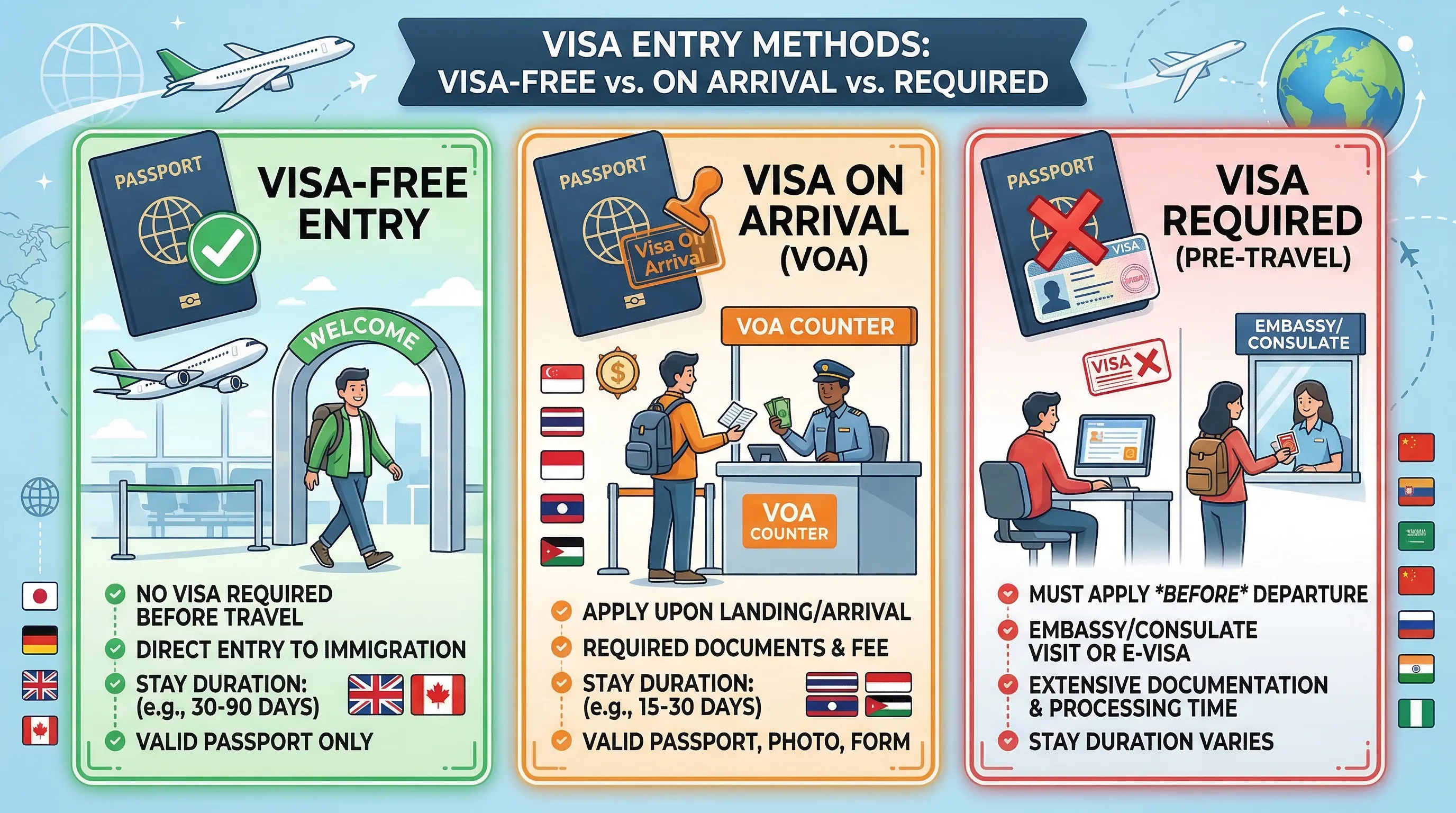
When we talk about international travel, three terms come up constantly, visa-free, visa on arrival, and eTA. They sound similar, but they work differently, carry different risks, and apply to different passport holders. Confusing them at the airport can mean a denied boarding pass or a turned-away entry at immigration. This guide breaks down exactly what each authorization means, how they compare, and how to figure out which one applies to your passport.
Key Takeaways
- Visa-free, visa on arrival, and eTA are three legally distinct entry systems — confusing them can result in denied boarding or refusal at immigration.
- True visa-free entry requires zero pre-travel authorization, but most passport holders still face conditions like stay limits, proof of funds, and border officer discretion.
- A visa on arrival is granted at the port of entry and typically requires cash payment, supporting documents, and 10–30 minutes of processing time — with no guarantee of approval.
- An eTA must be secured online before your flight departs, as airlines — not immigration officers — will deny boarding if you arrive at the airport without one.
- Entry requirements shift frequently due to changing diplomatic agreements, so always verify your specific authorization type with the official immigration authority of your destination country.
- For travelers evaluating a second passport or citizenship by investment, understanding whether new access is visa-free, eTA-based, or visa on arrival is critical to accurately measuring real-world travel freedom.
Why These Travel Authorizations Matter
Visa-free access, visa on arrival, and eTA are not interchangeable; each represents a distinct legal framework governing how foreign nationals enter a country. Getting this wrong isn't just inconvenient: airlines can deny boarding to passengers who lack the correct pre-travel clearance, even before they reach immigration.
As of 2025, the Henley Passport Index ranks passports by the number of destinations accessible without a prior visa. Japan and Singapore lead with access to over 193 destinations. But "access" encompasses all three types of entry, and that distinction matters enormously in practice. Our breakdown of the passports with the most visa-free countries in 2026 shows why the headline number is useful, but incomplete without understanding the authorization type behind it.
At Passport Factory, we work with globally mobile individuals who frequently discover, mid-trip planning, that what they assumed was visa-free entry actually requires an eTA or a border-issued visa. Understanding the difference protects your travel plans and your time.
These entry systems also reflect diplomatic relationships between nations. A change in bilateral agreements, like Canada's reinstatement of a visa requirement for Mexican citizens in February 2023, can affect millions of travellers overnight. Staying informed about the correct authorization type for your passport is not optional: it's foundational travel literacy. If you want to understand how these changes flow into rankings and published mobility scores, read our guide on how passport rankings are calculated.
What Does Visa-Free Entry Actually Mean?
Visa-free entry means a passport holder can enter a foreign country without applying for any visa, before or upon arrival. No application form, no fee, no advance approval. You present your passport at immigration, and entry is granted based on your nationality alone.
For example, German passport holders can enter the United States for up to 90 days under the Visa Waiver Program (VWP), but they still need an approved ESTA (Electronic System for Travel Authorization) before boarding. This is where the confusion begins.
True visa-free access, with zero pre-travel authorization required, exists between countries like those in the EU's Schengen Area. A French citizen traveling to Germany needs only a valid ID. No app, no fee, no form.
If you're evaluating how your current passport ranks for genuine visa-free access, our passport index comparison tool can help you see exactly which destinations fall into each category.
Common Misconceptions About Visa-Free Travel
The most common mistake we see is conflating "visa-free" with "no requirements at all." Visa-free does not mean:
- You can stay indefinitely (most visa-free periods are 30–90 days)
- You can work or study without a separate permit
- You're exempt from border officer discretion, entry can still be refused
- You don't need a pre-authorization like an ESTA or eTA
Another misconception: that a strong passport guarantees smooth entry. Even high-ranking passport holders can be denied entry if they can't prove onward travel, sufficient funds, or a clear purpose of visit. Visa-free is a privilege, not a guarantee.
How Visa on Arrival Works
A visa on arrival (VOA) is issued at the port of entry, the airport, land crossing, or seaport, rather than at a consulate before travel. You apply in person upon arrival, pay a fee, and receive a stamp or sticker that authorizes your entry.
Thailand is one of the most well-known examples. As of late 2024, Thailand offers visa-on-arrival to citizens of 19 specific nationalities, valid for 15 days, at a cost of THB 2,000 (approximately USD 55). The list of eligible nationalities is updated periodically by Thailand's Ministry of Foreign Affairs.
India also operates a VOA system (called e-Visa on Arrival at certain ports) for eligible nationalities arriving at designated international airports. Fees range from USD 25 to USD 80 depending on stay duration.
For travelers holding second passports or dual citizenship, VOA availability can shift significantly based on which passport they present at immigration.
What to Expect at the Border
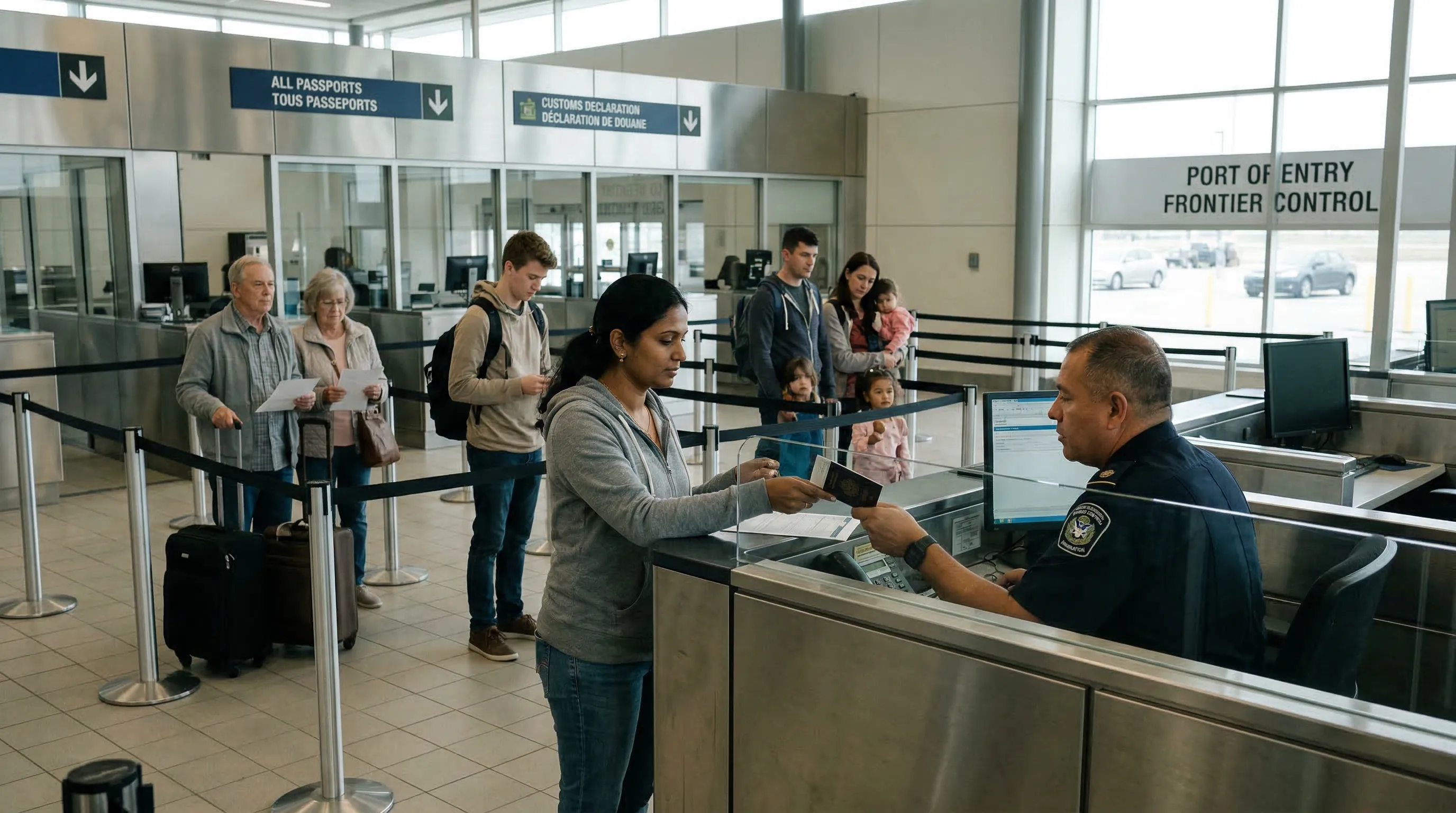
At a VOA counter, you'll typically need:
- A valid passport (usually with at least 6 months' validity) (You can check passport validity requirements using this tool)
- A completed arrival form (sometimes available on the aircraft)
- Proof of onward or return travel
- Proof of accommodation
- Sufficient funds (requirements vary by country)
- The exact visa fee in cash, often local currency or USD only
Processing time at the counter is usually 10–30 minutes, but queues at peak travel periods can extend significantly. We always recommend arriving with all documents organized and fee ready in cash to avoid delays.
Understanding the Electronic Travel Authorization (eTA)
An Electronic Travel Authorization (eTA) is a pre-travel, electronically linked permission that authorizes eligible foreign nationals to board a flight to a specific country. It's not a visa, but it's not truly visa-free either. It sits in a middle category that many travellers underestimate.
Canada's eTA system, launched in 2016, is one of the clearest examples. Visa-exempt foreign nationals flying to Canada must obtain an eTA before departure. The fee is CAD 7, the process is online, and approval typically comes within minutes, though the Government of Canada recommends applying at least 72 hours before travel.
Australia operates the Electronic Travel Authority (also called ETA), required for passport holders from countries like the United States, Canada, and Japan for stays up to 3 months. As of 2024, Australian ETA applications cost AUD 20 via the official ETA app.
The UK introduced its own Electronic Travel Authorization (ETA) in 2024, rolling it out in phases. Non-visa nationals from the US, Canada, Australia, and several Gulf Cooperation Council countries are now required to obtain a UK ETA before arrival. The cost is £10.
For travelers managing multiple passport renewals or citizenship-by-investment documentation, understanding which passport triggers eTA requirements versus a full visa is essential for trip planning.
How to Apply for an eTA
The application process is almost entirely digital:
- Visit the official government immigration portal for your destination country
- Enter your passport details, travel history, and personal information
- Pay the required fee (typically USD 7–USD 20 equivalent)
- Receive approval via email, the authorization is electronically linked to your passport
- Present your passport at check-in and upon arrival (no physical document required)
Approval is usually instantaneous or within a few hours. But, some applications are flagged for additional review, which can take up to 72 hours. Never book non-refundable flights before receiving eTA confirmation.
Key Differences Between Visa-Free, Visa on Arrival, and eTA
Here's a direct comparison of all three travel authorization types:
| Option | Program | Core requirement | Approx. threshold / best fit | Note | Source |
|---|---|---|---|---|---|
| Visa-free entry | No pre-travel visa authorization | Passport holders enter without applying for a visa before or on arrival, while still meeting border-entry conditions | Best fit: lowest-friction travel when reciprocal access is strong | No advance filing, but entry can still be refused at the border | Schengen travel rules |
| Visa on arrival | Border-issued visa | Application happens at the airport, land border, or seaport on arrival, usually with supporting documents and a fee | Best fit: travelers whose nationality is eligible but not fully visa-exempt | Queue risk, cash requirements, and border discretion matter more here | Thailand visa information |
| eTA | Electronic Travel Authorization | Online pre-clearance linked to the passport before departure | Best fit: low-friction travel that still requires digital pre-approval before boarding | Airlines often block boarding if the eTA is missing, even before immigration review | Government of Canada eTA |
The critical operational difference: an eTA must be secured before you board your flight. If you arrive at the airport without one, the airline will typically deny boarding, not immigration. This is why eTAs catch travelers off guard more than the other two types. It's also the reason many travelers misread raw mobility rankings, especially when a destination is counted as "easy access" but still requires digital pre-clearance.
Visa on arrival carries a different risk: the possibility of long queues, cash-only counters, or denial at the border if documentation is insufficient. Visa-free entry, while the most frictionless, still requires meeting entry conditions.
For passport holders exploring residency or citizenship programs specifically to improve global mobility, knowing how each new passport changes your access type, not just the number of countries, is a key part of the value calculation.
How to Know Which One You Need
The most reliable source is always the official immigration authority of your destination country, not travel blogs, airline booking pages, or social media posts. Rules change, and they change fast.
Here's a practical checklist we recommend:
- Check your passport nationality against the destination country's official visa policy page
- Identify the entry type: Does your nationality require a visa, VOA, eTA, or are you visa-exempt?
- Confirm the port of entry: Not all entry points offer VOA: some eTAs are flight-only (not applicable for land or sea borders)
- Verify stay duration limits: Visa-free and eTA periods vary, Canada allows up to 6 months, Australia's ETA allows up to 3 months per visit
- Check passport validity: Most countries require at least 6 months beyond your intended stay
- Review recent policy changes: The UK ETA, for example, only became mandatory for US citizens arriving at UK airports in January 2025
For Indian passport holders, one of the largest groups we work with at Passport Factory, the entry type varies dramatically by destination. India ranks 80th on the 2025 Henley Index, with access to approximately 58 visa-free or VOA destinations, compared to 193+ for Japanese passport holders.
If you're evaluating a second citizenship or passport to expand your travel access, it's worth mapping not just how many countries open up, but specifically how they open, because eTA access and visa-free access are not the same experience at the border.
Conclusion
Visa-free, visa on arrival, and eTA are three distinct systems, and treating them as equivalent is one of the most common (and avoidable) travel mistakes. Each has different timing, cost, risk, and process requirements.
As global entry systems grow more digital, with the EU's EES (Entry/Exit System) and ETIAS (European Travel Information and Authorisation System) both scheduled to roll out through 2025–2026, the category of "pre-travel digital authorization" will only expand. More countries will move away from visa-on-arrival models toward eTA-style systems, making it even more important to check before you fly.
Frequently Asked Questions: Visa-Free vs Visa on Arrival vs eTA
What is the main difference between visa-free, visa on arrival, and eTA?
Visa-free entry requires no application or fee — just your passport. Visa on arrival is issued at the border upon arrival, with a fee and paperwork. An eTA (Electronic Travel Authorization) must be approved online before you fly. Each represents a distinct legal entry framework with different costs, timing, and risks.
Do I need to apply for anything before traveling if I have visa-free access?
Not always — but sometimes yes. True visa-free travel (like within the EU's Schengen Area) requires no pre-travel process. However, some countries labeled 'visa-free' still require an eTA or ESTA before boarding. Always check the destination country's official immigration page to confirm whether any pre-authorization is needed.
What happens if I arrive at the airport without an eTA?
The airline will typically deny boarding before you even reach immigration. Unlike visa on arrival, an eTA must be secured digitally before departure. Since it's electronically linked to your passport, airlines verify it at check-in. Never book non-refundable flights without confirmed eTA approval, as some applications can take up to 72 hours.
How much does a visa on arrival typically cost, and what documents are required?
Visa on arrival fees generally range from USD 25 to USD 80 depending on the country and stay duration. You'll typically need a valid passport with at least 6 months validity, proof of onward travel, accommodation details, sufficient funds, and the exact fee in cash — often in local currency or USD.
Is an eTA the same as a visa?
No — an eTA is not a visa. It's a pre-travel electronic authorization that permits eligible travelers to board a flight to a specific country. It's faster, cheaper, and entirely digital, but it still involves an approval process and can be denied. It sits between full visa-free access and a traditional visa in terms of requirements.
How do I find out which entry type — visa-free, visa on arrival, or eTA — applies to my passport?
The most reliable source is the official immigration authority website of your destination country. Check your nationality against their visa policy, confirm the type of entry permitted, verify port-of-entry restrictions, and review stay duration limits. Entry rules change frequently, so always verify before booking — especially after policy updates like the UK ETA rollout in 2025.
Related Pages
- Passport Renewal Guide - How to renew your passport before your next trip: all methods, costs, and timelines
- Passport Validity Checker - Check if your passport meets destination entry requirements
- 10 Passports With the Most Visa-Free Countries in 2026 - Which passports open the most doors
- Best Passports for Digital Nomads 2026 - How passport strength affects banking, tax treatment, and remote work