Passport rankings calculation is more than a simple count of countries you can visit. The number attached to your passport's rank directly reflects a complex, rule-based scoring process, one that determines whether you need a visa, can land without one, or qualify for an electronic travel authorization instead.
Understanding how these rankings work helps globally mobile individuals, investors, and dual citizens make more informed decisions about second passports and citizenship programs. In this guide, we break down exactly how the scores are built, who builds them, and why they shift.
Key Takeaways
- Passport rankings calculation is based primarily on the number of destinations a passport holder can access visa-free or via visa-on-arrival, using data sourced largely from IATA's authoritative travel database.
- Electronic Travel Authorizations (ETAs) are treated differently across indexes — Henley counts them as visa-free, while Arton Capital separates them — meaning the same passport can appear stronger or weaker depending on which index you consult.
- Major indexes like the Henley Passport Index update rankings quarterly (with real-time pushes for major changes), so passport scores from even a few months ago may already be outdated.
- Passport rankings do not measure how easy or costly a passport is to obtain — the St. Kitts and Nevis passport, for example, is acquirable through investment in under six months yet outranks passports from far larger economies.
- The global passport power gap has widened significantly, growing from roughly 100 destinations between the top and bottom-ranked passports in 2015 to over 160 by 2026, making second citizenship an increasingly strategic consideration.
- Always use passport rankings as a starting point — cross-reference multiple indexes, check methodology pages, and verify current entry requirements through official government sources before making any citizenship or travel decisions.
What Passport Rankings Actually Measure
Passport rankings measure the number of destinations a passport holder can access without obtaining a visa in advance. This is called travel freedom or passport power, and it's the central metric behind every major index.
A higher rank means fewer pre-travel bureaucratic hurdles. A Japanese or Singaporean passport holder, for example, can currently access 193–194 destinations with minimal friction, placing those passports consistently at the top of global rankings. By contrast, an Afghan or Pakistani passport holder faces visa requirements in the vast majority of countries.
Importantly, rankings do not measure:
- Quality of life in the issuing country
- Ease of obtaining that passport
- Strength of the country's economy
- Right to work or settle abroad
They measure one thing: entry access. How many countries will let you in, with what conditions, and under what terms. That narrow definition is what makes the metric both powerful and limited. For those exploring second passport options, understanding this distinction is essential before making citizenship decisions based on rankings alone.
The Core Methodology Behind Passport Rankings
Counting Visa-Free and Visa-on-Arrival Access
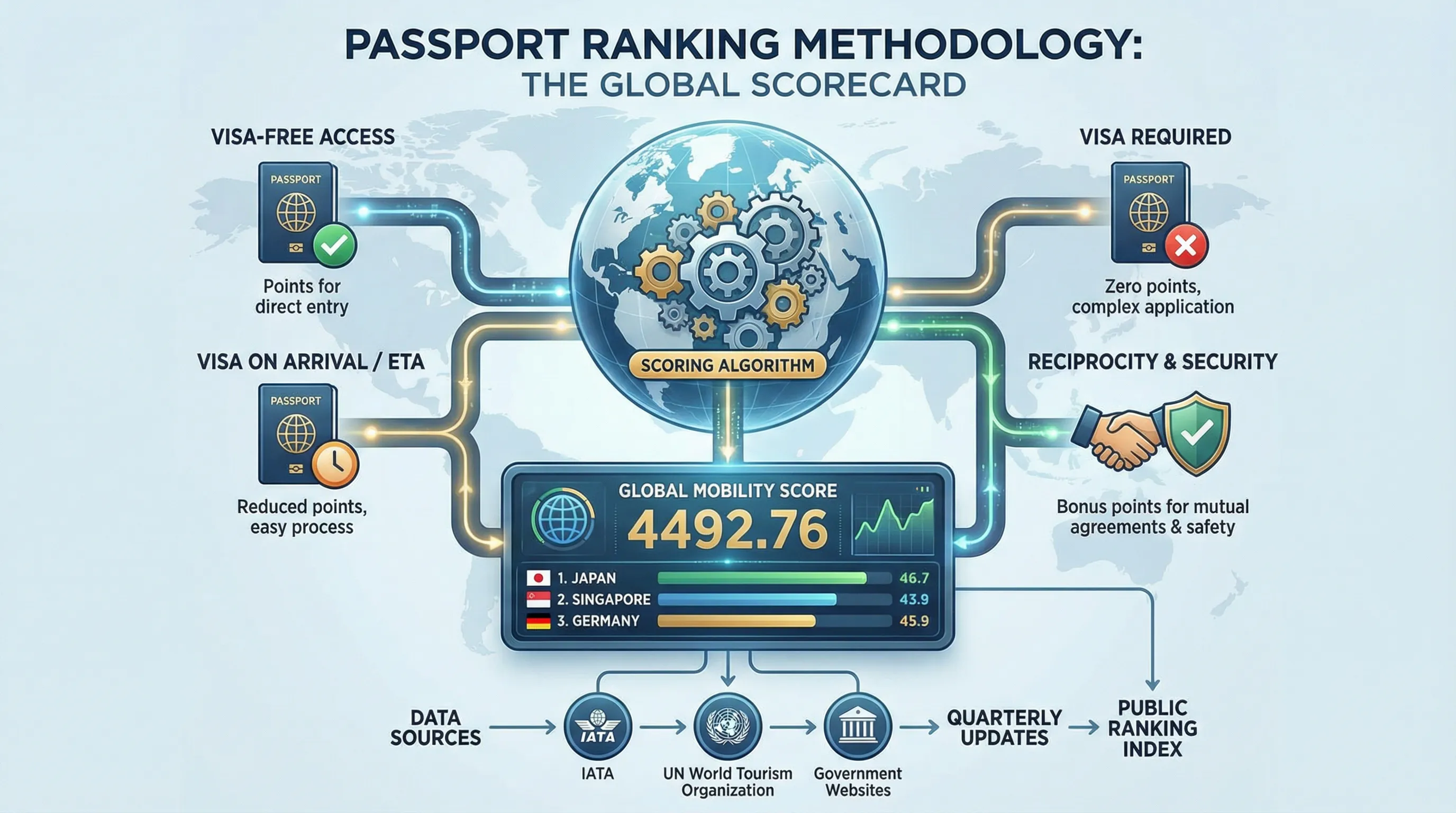
The foundation of passport rankings calculation is straightforward: count every destination a passport holder can enter without a pre-arranged visa. This includes two primary categories.
Visa-free access means no visa is required at all, you land, show your passport, and you're through. Visa-on-arrival (VOA) means you pay a fee and receive entry permission at the border, without applying in advance. Both are counted equally in most ranking methodologies.
As of early 2026, the Henley Passport Index, one of the most cited global benchmarks, awards one point per destination accessible either visa-free or via VOA. The index tracks 227 travel destinations across 199 passports. That's a significant dataset, updated continuously as bilateral agreements shift.
For globally mobile professionals considering a citizenship-by-investment program, the visa-free count is often the primary benchmark for evaluating the return on investment.
How Electronic Travel Authorizations Are Factored In
Electronic Travel Authorizations (ETAs) are where methodologies diverge, and where rankings can mislead.
An ETA requires online pre-approval before travel. Countries like Canada (eTA), Australia (ETA), and the United Kingdom (ETA launched in 2024) require these for many passport holders. Some indexes, including the Henley Passport Index, count ETA-required destinations as visa-free because no physical visa application or embassy visit is involved. Others treat ETAs as a separate, lesser category. For a practical explanation of how visa-free access differs from visa on arrival and eTA in real travel planning, see our guide to visa-free vs visa on arrival vs eTA.
This distinction matters. A passport with 190 "visa-free" destinations according to passport factory rankings index might include 20+ ETA-required countries, a meaningful friction point that a raw number doesn't communicate. We recommend checking the index's methodology page directly before using rankings to make residency or passport decisions, and pairing the raw ranking with a destination-by-destination access review.
Who Compiles Passport Ranking Data and How
Primary Sources and Data Collection Methods
Three organizations dominate global passport ranking data:
- Henley & Partners publishes the Henley Passport Index, sourcing data directly from the International Air Transport Association (IATA), which maintains the world's most comprehensive travel information database used by airlines and governments.
- Arton Capital publishes the Passport Index, which includes ETAs as a separate access tier.
- Nomad Passport Index – Weighs additional factors like taxation, global perception, and dual citizenship restrictions, making it a broader lifestyle index rather than a pure access score.
IATA's Travel Centre database is the authoritative backend for most rankings. IATA updates its data in near real-time as countries modify entry requirements. This makes the Henley Index, which draws on IATA data, one of the most reliable sources for raw access scores.
For those researching passport renewal processes or comparing dual citizenship countries, knowing which index uses which source is critical for accurate decision-making.
How Often Rankings Are Updated
The Henley Passport Index updates its rankings quarterly, with additional real-time updates pushed when major visa policy changes occur. Arton Capital's Passport Index updates in real-time as agreements are confirmed.
Policy changes that trigger updates include:
- New bilateral visa waiver agreements (e.g., the EU–Gulf Cooperation Council visa waiver discussions ongoing in 2025)
- Suspension of visa-free access due to diplomatic tensions
- Introduction or removal of ETA requirements
In 2023, for instance, the UK's introduction of its ETA scheme shifted how several passports were scored across different indexes. These updates are why a ranking from 12 months ago may already be outdated. We track these shifts regularly in our visa policy updates section.
Why Passport Rankings Change Over Time

Passport rankings change because international relations change. Visa policy is fundamentally a diplomatic tool, and bilateral agreements are negotiated, suspended, or expanded in line with political priorities.
Here's what drives movement in the rankings:
- New visa waiver treaties: When the EU signs a visa-free agreement with a country, multiple European passports can gain several new destinations simultaneously.
- Reciprocal retaliation: If Country A imposes new visa rules on Country B, Country B often responds in kind, causing both passports to drop.
- Security reclassifications: A country experiencing political instability may have its citizens' visa-free access to key destinations suspended.
- Citizenship-by-investment programs: Countries like Malta, Grenada, and Vanuatu have actively lobbied for expanded visa-free access to boost the appeal of their citizenship programs. Grenada's passport, for example, provides visa-free access to China, a rare benefit tied specifically to diplomatic relations rather than geography.
Over the past decade, the gap between the most and least powerful passports has widened. In 2015, the gap between the top-ranked and bottom-ranked passports was roughly 100 destinations. By 2026, that gap has grown to over 160, according to Henley data. This growing inequality in passport power is a key reason why second citizenship has become a serious consideration for high-net-worth individuals and globally mobile families.
Common Misconceptions About Passport Rankings
Several widespread misunderstandings affect how people interpret and use passport ranking data.
Misconception 1: A higher rank means visa-free access everywhere.
No passport grants global visa-free access. Even the top-ranked Japanese passport requires visas for destinations like North Korea, Afghanistan, and several Pacific island states. Rankings reflect access to a subset of global destinations, not all of them.
Misconception 2: All indexes use the same methodology.
They don't. As discussed, Henley counts ETAs as visa-free. Arton separates them. The Nomad Passport Index factors in tax obligations and personal freedom scores. Comparing rankings across indexes without accounting for methodology differences leads to incorrect conclusions. Always verify which passport index you're referencing.
Misconception 3: Rankings reflect how easy it is to get the passport.
A passport's travel power has no relationship to how difficult or expensive acquiring it is. The St. Kitts and Nevis passport, for example, can be obtained through investment in under six months and ranks significantly higher than passports from much larger economies.
Misconception 4: Rankings are stable.
Rankings can shift within weeks. A single diplomatic incident or new treaty can add or remove 10–20 destinations from a passport's score almost overnight. Treating rankings as fixed data leads to outdated planning.
Conclusion
Passport rankings calculation is a structured, data-driven process, but one with real nuance beneath the surface. The raw score reflects visa-free and visa-on-arrival access across a defined set of destinations, compiled primarily from IATA data and updated quarterly or in real-time depending on the index.
What rankings don't tell you: how easy a passport is to obtain, its tax implications, or whether an ETA counts as true visa-free access. For anyone evaluating a second passport or a citizenship by investment program, these distinctions are what separate informed planning from surface-level comparisons.
We recommend using rankings as a starting point, not a conclusion. Cross-reference multiple indexes, confirm policy dates, and always validate entry requirements through official government portals before making decisions based on ranking data.