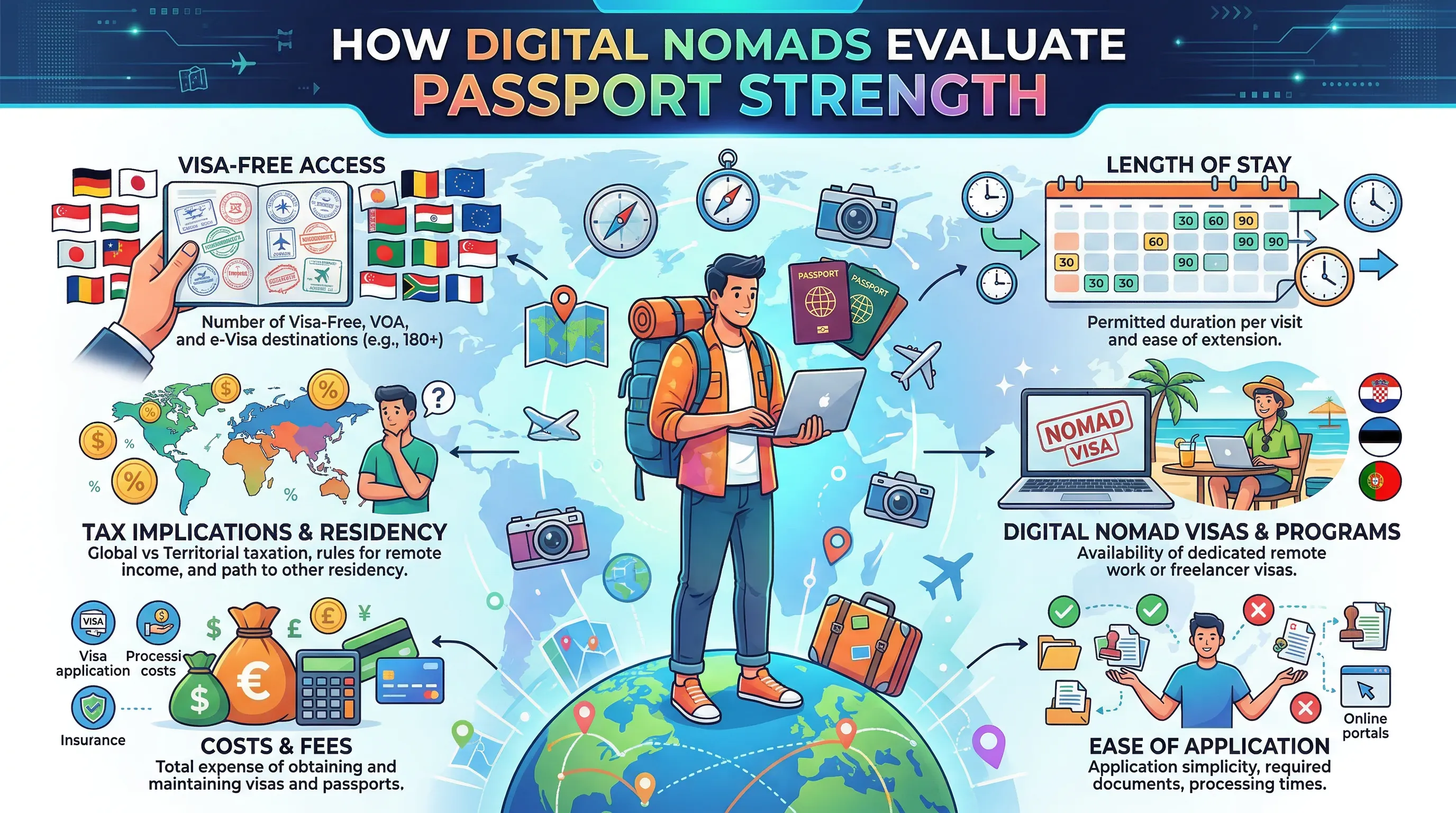
Passport strength isn't just a travel perk, for digital nomads, it's a foundational piece of their entire lifestyle. Where you can go, how long you can stay, and whether you even qualify for a digital nomad visa all trace back to the document in your pocket.
We've seen firsthand how a passport ranking difference of 20 positions can translate into months of added visa bureaucracy, higher travel costs, and real restrictions on where someone can base themselves for work. This article breaks down exactly how location-independent professionals assess passport strength, what metrics actually matter in practice, and what options exist for nomads working with weaker travel documents.
If you're new to the terminology behind these mobility scores, start with our guide to visa-free vs visa on arrival vs eTA before comparing nomad-friendly passports side by side.
Key Takeaways
- Passport strength is a core operational factor for digital nomads — it directly determines visa processing time, entry eligibility, banking access, and the ability to qualify for remote work permits abroad.
- As of early 2026, the gap between the strongest passports (195 destinations) and weakest (28 destinations) translates into a massive difference in mobility freedom, higher travel costs, and months of added bureaucracy for nomads.
- Visa-free country count alone doesn't tell the full story — entry conditions like maximum stay duration, extension eligibility, and proof-of-income thresholds are equally critical when evaluating passport strength for nomadic living.
- Most digital nomad visa programs, including Portugal's D8 and Spain's Startup Law visa, are passport-neutral by design, but holders of weaker passports face noticeably higher documentation burdens and slower processing times.
- Nomads traveling on passports ranked below 60 globally can offset limitations by applying for long-stay visas in advance, building a clean travel history, and exploring residency-by-investment programs in countries like Malta, UAE, or Panama.
- Second citizenship pathways — ranging from St. Kitts and Nevis fast-track programs to strategic naturalization routes — have become more accessible and can permanently expand passport strength for location-independent professionals.
Why Passport Strength Matters More for Digital Nomads
Passport strength shapes every logistical decision a digital nomad makes, from choosing a base country to planning client meetings abroad. Unlike occasional travelers, nomads aren't booking one trip a year. They're crossing borders multiple times per quarter, often on short notice.
According to the Passport Factory passport index, as of early 2026, Singapore holds the top spot globally with visa-free or visa-on-arrival access to 192 destinations. By contrast, an Afghan passport provides access to just 28. That's not a minor gap, it's the difference between spontaneous mobility and months of consulate appointments.
For nomads specifically, passport strength affects:
- Visa processing time, weaker passports often require full applications, notarized documents, and in-person interviews, adding weeks of lead time.
- Entry eligibility, some countries restrict entry based on passport origin regardless of other credentials.
- Banking and financial access, certain fintech platforms and international banks use passport nationality as a screening factor.
- Digital nomad visa access, many programs, like Portugal's D8 visa or Spain's digital nomad visa, don't explicitly discriminate by passport, but the supporting documentation requirements vary significantly.
We consistently see that nomads holding passports from the top 20 countries on the Passport Index operate with far fewer friction points than those in the 60–100 range. The lifestyle freedom that remote work promises is, in practice, partially gated by nationality.
Key Factors Digital Nomads Use to Assess Passport Strength
Visa-Free and Visa-on-Arrival Access
The most cited metric in any passport evaluation is visa-free access, the number of countries a passport holder can enter without arranging a visa beforehand. This number, tracked by indexes like the Henley Passport Index and the Arton Capital Passport Index, is updated quarterly as bilateral agreements change.
As of Q1 2026:
- Japanese passport: 193 destinations visa-free or visa-on-arrival
- German passport: 192 destinations
- Indian passport: 58 destinations
- Pakistani passport: 33 destinations
For nomads, we look beyond raw numbers. Visa-on-arrival access to a country like Thailand or Indonesia is useful, but if the stamp limits you to 30 days with no extension path, it's only half the picture. We also track which specific destinations are accessible, not just how many. A passport that opens doors to Western Europe, Japan, and the US is categorically more useful for most nomads than one with equivalent numbers concentrated in low-demand regions. Our article on how passport rankings are calculated explains why these headline counts need context before nomads rely on them operationally.
Visa Duration and Entry Conditions
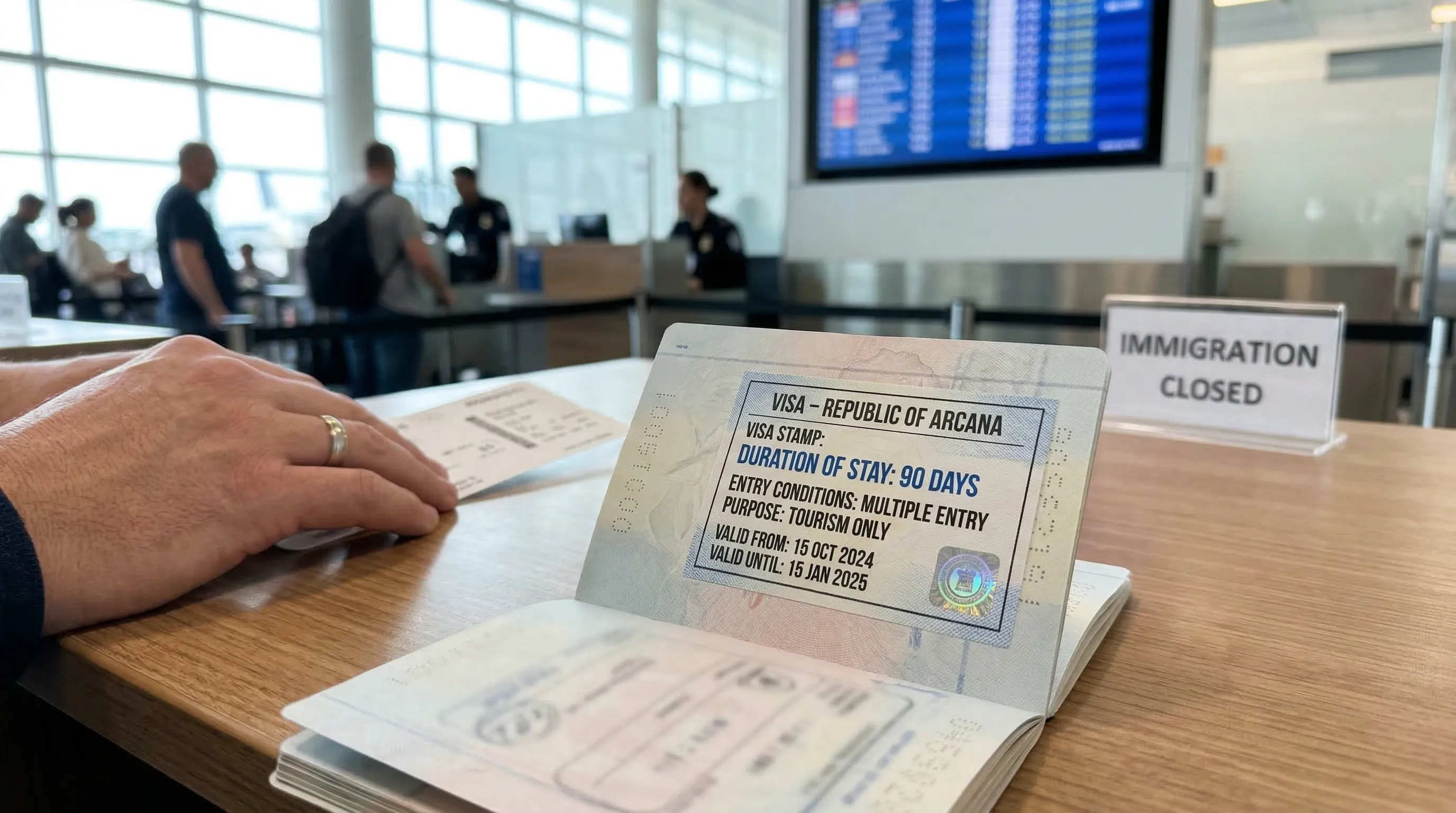
Visa duration and entry conditions are where passport comparisons get granular, and where many nomads make costly assumptions. A visa-free entry to the Schengen Area, for example, allows most non-EU passport holders to stay for up to 90 days within any 180-day period. Overstaying triggers bans that can derail an entire year of travel plans.
Conditions that we actively evaluate include:
- Maximum stay per entry (30, 60, or 90 days)
- Single vs. multiple entry permissions
- Extension eligibility once in-country
- Proof of onward travel requirements, some border agents enforce this strictly; others don't
- Financial proof thresholds, Portugal, for instance, applies income tests that materially affect long-stay and remote-work applicants
The practical implication: two passports with identical visa-free country counts can have dramatically different real-world utility depending on entry conditions.
Digital Nomad Visa Eligibility
As of early 2026, over 60 countries have introduced some form of digital nomad visa or remote work permit. These programs are generally passport-neutral, meaning eligibility is based on income, remote employment status, and health insurance, not nationality.
But, passport strength affects how easily a nomad can satisfy supporting requirements. For example:
- Bank statement verification is harder for holders of passports from countries with restricted international banking
- Travel history, a clean travel history from a strong-passport country signals lower immigration risk, which can accelerate processing
- Background check requirements vary by country of origin
Portugal's D8 Passive Income and Digital Nomad Visa requires a minimum monthly income threshold and a clean criminal record, while Spain's Ley de Startups visa has similar income and documentation requirements. Neither explicitly bars applicants by passport, but the documentation burden is noticeably higher for applicants from certain regions. Because these thresholds and evidentiary rules move, nomads should verify them on the official AIMA portal for Portugal and the Spanish Ministry of Foreign Affairs before applying.
How Passport Strength Affects Day-to-Day Nomadic Life
Passport strength isn't only felt at the border. It shapes the texture of daily nomadic life in ways that aren't always obvious until you're living them.
Consider co-working visa processing. Bali's Indonesia digital nomad visa, officially launched in 2023, is open to all nationalities but requires applicants to process applications at Indonesian consulates. For passport holders from countries without a nearby consulate network, this adds significant travel cost and time before even arriving.
In our experience working with globally mobile individuals, holders of weaker passports also face:
- Higher travel insurance premiums in some cases, tied to nationality-based risk ratings
- Airbnb and housing restrictions in certain countries that run nationality checks
- Currency and remittance friction, particularly for nomads earning in weaker currencies while paying expenses in USD or EUR
There's also the mental load factor, less discussed but very real. Constantly tracking visa expiries, planning trips around entry conditions, and maintaining documentation for every crossing is cognitively exhausting. Nomads with strong passports absorb this as a minor background task. For others, it becomes a part-time job. That's one reason why many remote workers care less about raw ranking prestige and more about whether a passport offers genuinely low-friction access to the places they actually want to spend time in.
A citizenship by investment program or naturalization pathway can permanently shift this dynamic, something we help clients evaluate based on their lifestyle and financial profile. If you're comparing stronger documents that still feel underappreciated for remote work, our roundup of surprising countries with strong passports is a useful next read.
Tools and Resources Digital Nomads Use to Compare Passports
Evaluating passport strength requires reliable, regularly updated data. We use and recommend a short list of tools that nomads consistently turn to:
1. Henley Passport Index, updated quarterly using data from the International Air Transport Association (IATA). It's the most widely cited index and uses real-time bilateral agreement data.
2. Nomad List, primarily a city-ranking tool, but it includes visa and entry-condition overlays filtered by passport. Useful for destination-specific planning.
3. PassportFactory.com Passport Index, our own comparison resource, structured specifically for readers who want to cross-reference passport rankings with visa application pathways, citizenship options, and nomad visa eligibility in one place.
4. IATA Travel Centre, the source data behind most indexes. Professionals and frequent travelers use this for precise entry requirements, including health documentation and landing card specifics.
5. Official government portals, For the most accurate visa rules, always cross-reference with the destination country's immigration authority. For example, Portugal's SEF/AIMA portal and Spain's Ministry of Foreign Affairs publish current requirements directly.
A practical workflow we follow: use the Henley Index for a macro passport ranking, then use country-specific government portals to verify exact entry conditions before travel. No third-party tool, including our own, replaces an official source for final confirmation.
Strategies for Nomads Traveling on a Weaker Passport
Holding a passport ranked below 60 on global indexes doesn't make the nomadic lifestyle impossible, but it demands more deliberate planning. Here are strategies we've seen work consistently.
Apply for long-stay visas in advance. Rather than relying on tourist entries, apply for digital nomad visas or long-term residence permits before arriving. Countries like Georgia (offering 365-day visa-free stays to most nationalities), Serbia (90 days, no visa required for most), and Albania (up to 1 year for some nationalities) offer accessible bases with minimal documentation friction.
Build a strong travel history early. A stamped passport with clean entry-exit records from Schengen countries, the US, or Japan significantly improves approval odds for future visa applications. Immigration officers across many countries informally use prior travel history as a credibility signal. This matters even more once you understand how indexes count access quality versus raw volume, which we cover in how passport rankings are calculated.
Consider residency programs as a long-term fix. Several countries offer residency by investment programs that grant a residence permit without requiring full-time physical presence. Malta, UAE, and Panama are popular choices. A residence permit from a well-regarded country can itself improve your visa application success rates elsewhere.
Pursue naturalization strategically. If you're spending significant time in a country, track your days carefully. Many nomads accumulate qualifying residency without realizing it. Portugal requires 5 years of legal residency for naturalization: Panama's Friendly Nations Visa can lead to citizenship in as few as 5 years, depending on the pathway.
Use passport renewal services to ensure your current passport is in optimal condition, expired or damaged passports create unnecessary complications at borders, especially for nationalities already subject to heightened scrutiny.
For those considering a second passport through investment or ancestry, processing times currently range from 3 months (St. Kitts and Nevis fast-track, approximately $250,000 USD minimum investment) to 10+ years for naturalization-based routes. The right path depends on budget, timeline, and where you plan to spend most of your time. For a practical benchmark of which passports currently offer the broadest travel access, compare this against our list of the passports with the most visa-free countries in 2026.
Conclusion
Passport strength is a practical, operational variable, not just a ranking to feel good or bad about. For digital nomads, understanding exactly what your passport enables and restricts is as important as knowing your tax obligations or having a reliable internet connection.
The gap between the world's strongest and weakest passports represents a gap in mobility freedom that compounds over time: missed opportunities, higher costs, and avoidable friction. But that gap is also narrowing through strategic choices, residency programs, digital nomad visas, and second citizenship pathways have all become more accessible in the last five years.
We recommend starting with an honest audit of your current passport's capabilities using a reliable index, then mapping that against your actual travel needs. From there, whether the answer is a targeted visa strategy or a longer-term citizenship by investment plan, you'll be making decisions based on real data, not assumptions.