
The best passport for a digital nomad is not the one with the most visa-free stamps. It is the one that lets you open a Wise account without a compliance review, file taxes in one country instead of three, and qualify for a nomad visa without a six-month paper chase. Singapore leads the Henley Passport Index with 195 visa-free destinations, but Malta took the number one spot on the 2026 Nomad Passport Index because it scores higher on taxation, dual citizenship rights, and personal freedom. That split tells you everything about why traditional passport rankings mislead nomads.
We ranked passports below using four criteria that actually determine day-to-day nomad quality of life: visa-free mobility, digital nomad visa friction, tax burden on foreign income, and banking platform access. If your passport scores poorly on any one of these, the other three cannot fully compensate.
Quick Comparison: Top Passports for Digital Nomads
| Passport | Visa-Free Destinations | Tax on Foreign Income | Nomad Visa Friction | Banking Access | Best For |
|---|---|---|---|---|---|
| Germany | 194 | Progressive (up to 45%), but Freiberufler structure available | Very low: EU freedom of movement + strong acceptance globally | Near-zero friction on Wise, Revolut, Payoneer | EU-based freelancers wanting maximum mobility |
| Singapore | 195 | Territorial: foreign-sourced income not taxed | Low globally, but no EU freedom of movement | Excellent: global fintech hub status | Asia-Pacific operators who want tax efficiency |
| Canada | 185 | Worldwide taxation, but no FATCA-style reporting abroad | Low: strong acceptance across nomad visa programs | Near-zero friction | Americas-based nomads who want simplicity over the US tax burden |
| United States | 186 | Worldwide + FATCA. FEIE excludes up to $132,900 in 2026 | Low: widely accepted for nomad visas | Near-zero friction | High earners who can use FEIE + foreign tax credits effectively |
| Japan | 193 | Worldwide if resident; territorial if non-resident | Moderate: strong travel access, but Japan's own immigration is restrictive | Good, though some EU fintechs limit Japanese nationals | High-mobility nomads focused on Asia and Middle East |
| Portugal | 191 | NHR/IFICI+ regime: 20% flat rate on qualifying foreign income for 10 years | Very low: EU freedom of movement | Near-zero friction | Nomads building toward EU citizenship via the D8 pathway |
| South Korea | 192 | Worldwide if resident | Low-moderate: Workation Visa (K-ETA eligible) since 2023 | Good | Tech workers splitting time between Asia and the West |
Why the Henley Index and the Nomad Passport Index Disagree
Most "best passport" articles cite one ranking. Nomads need to understand two, because they measure different things.
The Henley Passport Index counts visa-free and visa-on-arrival destinations. Singapore, Japan, and Germany dominate. This matters for short trips and border crossings, but it tells you nothing about tax treatment, dual citizenship rules, or whether your passport lets you open a multi-currency business account.
The Nomad Capitalist Passport Index weights five factors: visa-free travel, taxation, global perception, dual citizenship policy, and personal freedom. In 2026, Malta ranks #1, Greece and Ireland tie for #2, and Cyprus holds #5. These countries score lower on raw visa-free numbers but higher on the variables that determine whether you can actually build a location-independent life.
The practical takeaway: if you only care about entering countries, optimize for Henley. If you care about living and working across borders with minimal friction, the Nomad Index criteria matter more. Most digital nomads need a blend of both.
How Tax Treatment Separates Good Passports from Great Ones
Tax is where passport choice costs or saves nomads real money. Three models dominate:
Territorial taxation (Singapore, Panama, Costa Rica, Hong Kong): only income sourced domestically is taxed. Foreign-sourced freelance income from a Singaporean passport holder working remotely for US clients is not taxed by Singapore. This is the cleanest model for nomads.
Worldwide taxation without FATCA (Canada, Australia, most EU states): your home country taxes global income, but foreign institutions are not required to report your accounts to your government. This creates natural planning flexibility that US citizens do not have.
Worldwide taxation with FATCA (United States only): the US taxes citizens on worldwide income regardless of residence, and FATCA compels foreign banks to report American account holders to the IRS. The Foreign Earned Income Exclusion (FEIE) allows qualifying Americans to exclude up to $132,900 in 2026, which covers most nomad salaries. But high earners, those with investment income, or those who cannot meet the physical presence test face a tax load no other passport imposes.
The break-even math matters here. A Canadian nomad earning $150,000 in freelance income from Portugal pays Portuguese tax (or uses the IFICI+ regime). A US nomad earning $150,000 in Portugal pays Portuguese tax and US tax on the amount exceeding $132,900, minus foreign tax credits. At $200,000 in income, the US passport's tax penalty over a Canadian passport can exceed $8,000-$12,000 annually depending on treaty application and state tax obligations.
Digital Nomad Visa Access: Which Passports Face the Least Friction?
Over 70 countries now offer formal digital nomad visa programs, but eligibility is not universal. Three filters determine whether your passport qualifies:
Sanctions and FATF status. Countries on the EU sanctions list or the FATF grey list face additional scrutiny or outright exclusion from programs like Portugal's D8 Visa. As of the February 2026 FATF plenary, Kuwait and Papua New Guinea were added to the grey list, joining an existing list that includes Nigeria, South Africa, Syria, Yemen, and others. Passport holders from grey-listed countries report longer processing times and higher rejection rates across EU nomad visa programs.
Reciprocal restrictions. Some programs explicitly limit eligibility by nationality. Portugal's D8 Visa is available to non-EU/EEA/Swiss nationals, meaning EU passport holders do not need it but also cannot use it as a pathway. Croatia's digital nomad visa similarly excludes EU/EEA citizens, who already have freedom of movement.
Income and documentation standards. The threshold varies enormously:
| Program | Monthly Income Required | Duration | Tax on Foreign Income | PR Pathway | Nationality Restriction |
|---|---|---|---|---|---|
| Spain (Digital Nomad Visa) | ~EUR 2,762 (200% of IPREM) | Up to 3+2 years | Beckham Law: 24% flat on Spanish-source | PR after 5 years | Non-EU/EEA |
| Portugal (D8 Visa) | EUR 3,680 | 1-2 years, renewable to 5 | IFICI+ may apply | PR after 5 years, citizenship after 5 more | Non-EU/EEA/Swiss |
| Hungary (White Card) | EUR 3,000 | 1+1 year | 0% if <183 days; 15% flat if resident | PR after 2 years | Non-EU/EEA |
| Thailand (DTV) | THB 500,000 bank balance (~$14,200) | 5-year multi-entry, 180 days per entry | Taxed if remitted in same year (2024 rule change) | No | Open to most nationalities |
| Costa Rica | USD 3,000 ($5,000 for families) | 1 year, renewable once | 0% on foreign income | PR in 3 years | Open to all |
| Georgia | USD 2,000 | 1 year | 0% if <183 days | No | Open to all |
| Barbados (Welcome Stamp) | USD 4,167 ($50,000/year) | 1 year, renewable | 0% | No | Open to all |
| Colombia | ~USD 684 (3x minimum wage) | 2 years | 0% on foreign income (non-residents) | No | Open to all |
EU, Canadian, US, and Japanese passport holders qualify for nearly every program on this list without additional scrutiny. Passport holders from FATF grey-listed countries should target nationality-unrestricted programs (Georgia, Barbados, Colombia) where income proof matters more than passport origin.
Banking Access: The Passport Filter Nobody Talks About
Visa-free travel means little if you cannot receive client payments or move money across borders. Fintech platforms that nomads depend on restrict access by passport nationality, not residence.
Wise operates in 160+ countries for sending but restricts account creation for nationals of sanctioned states. In 2025, Wise began requiring Russian and Belarusian passport holders in the EU to provide EU citizenship proof or permanent residence permits to maintain accounts. Nationals of Iran, North Korea, Syria, and Cuba cannot open Wise accounts at all.
Revolut personal accounts are available in approximately 40 countries, primarily UK, EEA, US, and select APAC markets. Most of Africa, South Asia, the Middle East, and Latin America is excluded from personal account registration. A Colombian freelancer with $10,000/month in revenue cannot open a Revolut account; a German freelancer earning $2,000/month can.
Payoneer has broader country coverage but applies enhanced due diligence to passport holders from FATF grey-listed nations, resulting in longer verification times (weeks instead of hours) and occasional account freezes during review.
The pattern is consistent: EU, US, UK, Canadian, Australian, Singaporean, and Japanese passport holders experience near-zero friction across all major platforms. Nationals of grey-listed or sanctioned countries face delays, denials, or account restrictions that directly impact cash flow. For a nomad whose income depends on receiving international payments within days, this is not a secondary consideration. It is existential.
Second Passport Strategy: When It Pays for Itself
A second passport is the nuclear option for nomads stuck with banking restrictions, limited visa-free access, or punishing tax regimes. The question is whether the math works.
Citizenship by investment (CBI) programs offer the fastest route. St. Kitts and Nevis starts at approximately $250,000 (contribution route), with processing in 60-90 days. Vanuatu's Development Support Program starts at approximately $130,000 with 30-60 day processing. Malta's Exceptional Investor Naturalization offers EU citizenship but requires EUR 600,000+ in contribution plus property and a 12-36 month residency period.
The break-even calculation for a US nomad earning $200,000/year: the annual FATCA tax penalty over a territorial-taxation passport is roughly $8,000-$12,000. A Vanuatu passport ($130,000 total cost, territorial taxation, 135+ visa-free destinations) pays for itself in approximately 11-16 years through tax savings alone, not counting the value of expanded visa-free access and banking optionality. For nomads earning $300,000+, the break-even drops to 7-10 years.
Ancestry-based EU citizenship is cheaper but slower. Italian citizenship by descent (jure sanguinis) costs approximately $5,000-$15,000 in legal and documentation fees, with processing taking 2-4 years through Italian consulates. Irish citizenship by descent through a grandparent born in Ireland requires Foreign Births Registration, processing in 6-18 months.
For Indian, Nigerian, Pakistani, and Bangladeshi passport holders, a second passport is often the single highest-ROI investment in a nomad career. It unlocks visa-free travel, banking access, and nomad visa eligibility simultaneously.
When Chasing Passport Optimization Is the Wrong Move
Not every nomad needs a second passport or a tax-optimized base. This strategy backfires in specific scenarios:
Your income is below $50,000/year. CBI programs, tax advisors, and relocation logistics cost money. A nomad earning $3,000/month is better served by a simple visa stack (Georgia + Thailand + Colombia rotate) than a $130,000 passport investment. Spend the money on skills and clients instead.
You plan to settle in one country. If your real goal is permanent residence in Portugal or Canada, a second passport from Vanuatu does not help. Apply for the D8 Visa or Express Entry directly. The passport-stacking strategy is designed for people who want to stay mobile, not for people who want to stop moving.
Your home country prohibits dual citizenship. Singapore, India, China, and Japan do not allow dual nationality. Acquiring a second passport means renouncing the first, which may cost you more in family ties, property rights, and home-country access than it gains. Indian passport holders exploring this route should consult an immigration attorney before proceeding, as the Citizenship Act consequences are severe and irreversible.
You are a US citizen hoping to escape FATCA. Renouncing US citizenship to avoid tax obligations is legal but carries a $2,350 renunciation fee and potential exit tax on unrealized gains. If your net worth exceeds $2 million or your average annual tax liability exceeded ~$201,000 over the prior 5 years, you are classified as a "covered expatriate" and taxed on the deemed sale of all assets. This is not a casual decision.
Practical Steps to Maximize Any Passport
Build a 12-month visa stack. Map visa lead times against your travel calendar. Portugal's D8 takes 60-90 days to process. Thailand's DTV takes approximately 30 days. Starting applications early prevents income gaps. A typical stack: base in Portugal (D8, up to 2 years) with DTV for Asia trips (180-day entries) and tourist visa rotations in Latin America.
Use tax treaties before you relocate. The US-Germany treaty prevents double taxation on freelance income. The US-Portugal treaty provides foreign tax credits. Canada's treaties with most OECD countries prevent source-country withholding beyond treaty rates. Identify which treaties apply to your passport and destination before committing, not after.
Open banking accounts before you need them. Apply for Wise, Revolut, and a local bank account in your base country while your documentation is fresh. Post-move applications face higher scrutiny. If your passport faces fintech restrictions, establish accounts in a jurisdiction where you hold residency first, then use those accounts for international transfers.
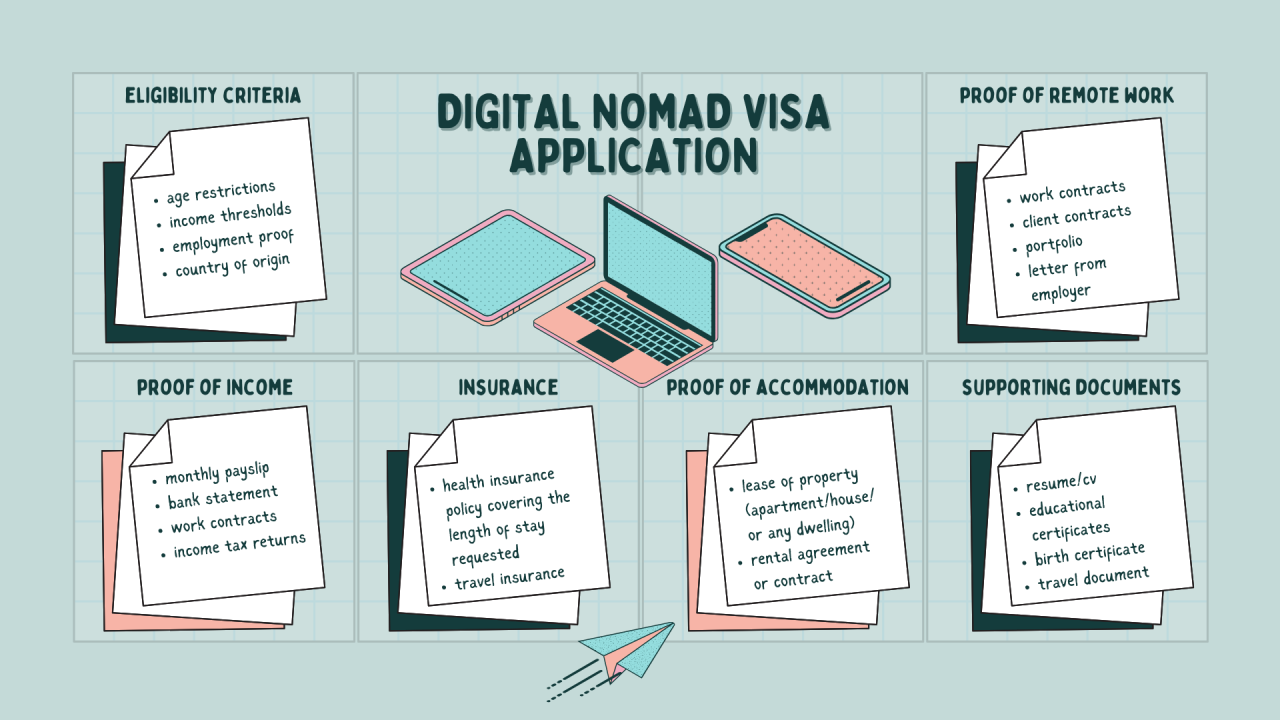
Maintain documentation readiness. Keep digital and physical copies of lease agreements, utility bills, residency letters, and tax returns organized. Nomad visa renewals, banking compliance checks, and tax filings all require overlapping documents. Services like Passport Factory's document support help ensure credentials remain valid and properly attested.
Related Pages
- Passport Renewal Guide - How to renew your passport: every method, cost, and timeline for 2026
- Best Digital Nomad Visas in 2026 - Side-by-side comparison of Spain, Croatia, Thailand, Estonia, Costa Rica, and Italy with official source verification
- How Digital Nomads Evaluate Passport Strength
- Top 10 Worst Passports for Digital Nomads in 2026
- 10 Passports With the Most Visa-Free Countries in 2026
- Visa-Free vs Visa on Arrival vs eTA
- Passport Comparison Tool - Compare any two passports side by side