The hardest part of a digital nomad visa file is usually not the money. It is proving the money in a way that looks stable, legal, and still true next month.
That is why applicants who clearly earn enough still get stuck. They submit screenshots, irregular statements, or one strong month of revenue and expect a consulate to infer the rest. It does not work like that.
Visa officers are not only checking whether you hit the threshold. They are checking whether your work relationship is real, ongoing, and compatible with the visa category.
What visa officers are actually trying to verify
When a country asks for proof of remote income, it is usually trying to answer four questions:
- Do you actually earn enough?
- Is the income lawful and ongoing?
- Is it tied to remote work outside the host country?
- Will that income still exist after you arrive?
That means strong evidence usually does two things at once:
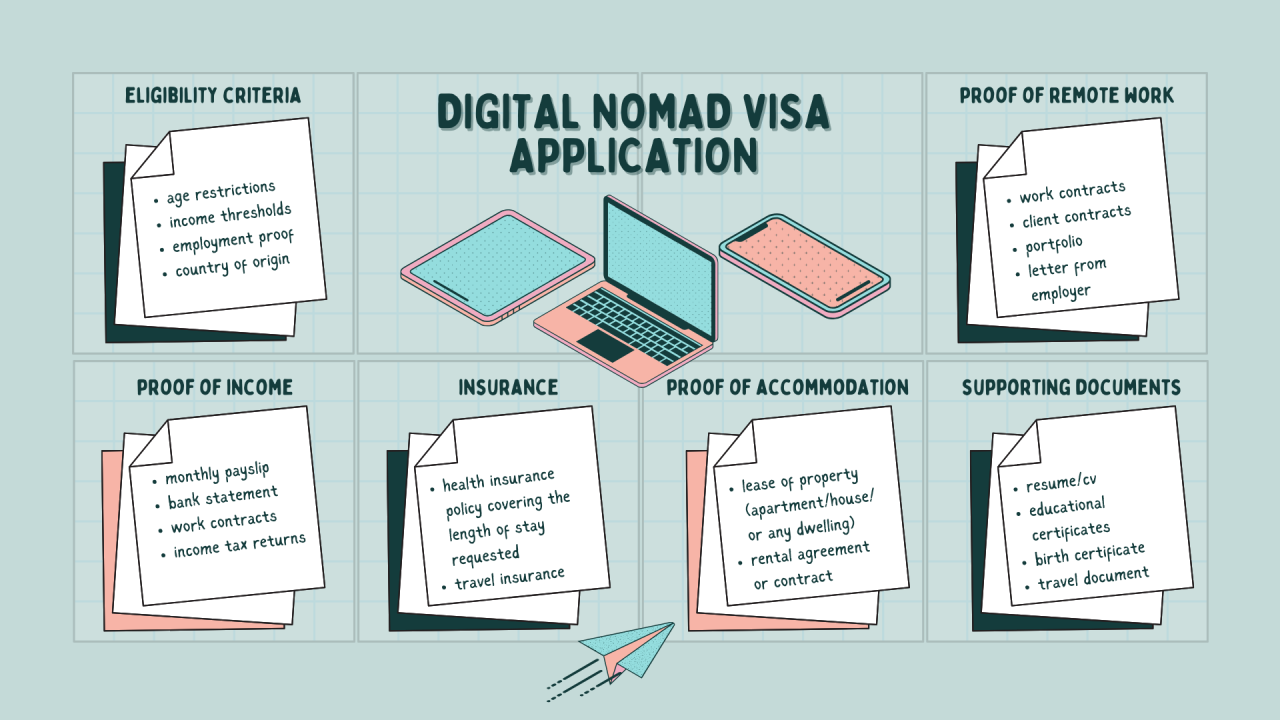
- proves the amount
- proves the continuity
This is where most weak files fail. They show one without the other.
| Option | Program | Core requirement | Approx. threshold / best fit | Note | Source |
|---|---|---|---|---|---|
| Salaried remote employee | Employee income route | Contract, payslips, employer letter, and matching bank deposits | Best fit: full-time remote employees | Weak files usually miss deposit trail or explicit remote-work language | Spain official guidance |
| Freelancer or consultant | Self-employed client route | Client contracts, invoices, matching bank statements, and tax records | Best fit: multi-client earners | One-off invoices and messy payment history weaken the file fast | Italy checklist |
| Founder paid through own company | Company-paid founder route | Company docs, service agreements, company/personal bank statements, and tax filings | Best fit: owners with a formal company structure | You have to connect company revenue to personal support clearly | Estonia official overview |
Best documents for salaried remote employees
Salaried applicants usually have the cleanest path if they present the documents in the right order.
Best core evidence:
- employment contract
- recent payslips
- employer letter confirming remote work status
- bank statements showing salary deposits
Spain’s official telework visa guidance, for example, explicitly points applicants toward documents proving the professional relationship, the ability to work remotely, and sufficient financial means. [Spain official guidance]
The trap for salaried workers is assuming the contract alone is enough. It usually is not. If the pay is not visibly landing in your account, or the employer letter is vague about remote work, a clean salary can still look weak.
Best documents for freelancers and consultants
Freelancers have a harder job because they have to prove a business relationship, not just an employment relationship.
The best evidence stack usually looks like this:
- signed client contracts
- recent invoices
- bank statements showing matching payments
- tax documents or accounting records where relevant
- a short client list summary if income comes from multiple sources
Why multiple layers? Because one invoice proves almost nothing. A run of invoices plus matching bank deposits plus current contracts starts to look like a real business.
This is also where digital nomad applicants panic unnecessarily. They think they need one perfect document. They usually need a coherent packet instead.
Side note: if your income only makes sense after a ten-minute verbal explanation, your paperwork is not ready yet.
Best documents for founders paid through their own company
This is the awkward middle category.
Founders often earn enough, but their money flow is less visually simple than a salary or a freelance invoice chain. If you are paid through your own company, the question becomes: how do you prove that the company is real, active, and able to support you?
Useful evidence can include:
- company registration documents
- service agreements or client contracts
- director or owner resolutions if relevant
- payroll records or dividend evidence, depending on structure
- company bank statements plus personal bank statements
- tax filings or accountant letters where needed
The goal is to close the credibility gap between “I own a company” and “this company actually generates the income I am claiming.”
Country examples: Spain, Estonia, Italy, and Croatia
This is where country-specific detail starts to matter.
Spain
Spain’s telework route puts heavy weight on proof of the professional relationship, proof of remote-work conditions, and proof of financial means. It also adds translation and legalization pressure. Strong file, but not light admin. [Spain]
If that is your route, the Spain visa paperwork guide covers the friction in more detail.
Estonia
Estonia’s digital nomad visa is cleaner on paper than most countries. The official page states the applicant must be able to work independently of location and show income of at least €4,500 net per month. [Estonia]
Italy
Italy is useful here because some of its digital nomad / remote worker checklists are unusually explicit about evidence types. Recent checklists reference bank statements, salary slips for employees, client contracts and invoices for self-employed applicants, and tax records. That makes Italy a good model for understanding what “prove remote income” really means in document terms. [Italy checklist example]
Croatia
Croatia’s digital nomad route is another reminder that proving income is not just about monthly salary. Official Croatian materials push applicants toward means-of-subsistence and bank-balance logic strongly enough that cash-position clarity becomes part of the file, not an optional extra. [Croatia official page]
The Croatia application guide is useful here because Croatia’s file gets much easier once the proof-of-funds story is organized properly.
If you are choosing between routes rather than just documents, the broader digital nomad visa comparison is the right next step.
The mistakes that make strong income look weak
These are the mistakes that matter most:
- bank statements that show income but not its source clearly
- contracts that are too old, vague, or already expired
- invoices with no matching deposits
- one giant lump sum standing in for ongoing earnings
- no explanation of mixed income streams
- untranslated or improperly legalized documents where translations are required
This is the part many applicants hate hearing: consulates do not only review your income. They review whether your paperwork tells one believable story.
What a convincing bank statement package actually looks like
Bank statements are where a lot of otherwise strong files become hard to trust.
The problem is rarely the existence of money. The problem is whether the statement lets the reviewer connect the dots without guessing. A persuasive set of statements usually does three things well:
- shows deposits arriving in a predictable pattern
- makes the source of those deposits understandable from the rest of the file
- avoids unexplained jumps that look like borrowed funds or one-off transfers
This is why screenshots are weak and exports are stronger. It is also why “I can explain that on a call” is not a real document strategy.
If you are self-employed, consistency matters almost more than a perfect monthly total. A smaller but believable run of income often reads better than one giant spike that technically clears the threshold and raises five new questions.
Translation, formatting, and continuity problems that look trivial until they are not
Applicants usually focus on the numbers first and the document chain second. That order causes trouble.
Continuity problems are what make good income look suspicious:
- a contract that has already expired
- a client payment history that does not match the invoices
- employer letters with job titles but no remote-work language
- translated documents that do not line up cleanly with the originals
Worth saying: the more countries ask for apostilles, official translations, or locally acceptable wording, the less this becomes a pure income question. It becomes a file-quality question. That is exactly why some people who earn more than enough still look weaker on paper than someone with a simpler, smaller, cleaner packet.
If you only remember one thing from this article, make it this: visa officers are not rewarding creative explanations. They are rewarding files that make sense fast.
That sounds harsh. It is also why simple, boring, well-matched evidence keeps beating flashy income stories that need interpretation.
A usable document order for the actual application packet
One thing applicants almost never optimize is document order. That sounds minor until you compare a chaotic file against one that leads the reviewer from identity to work model to income proof without forcing them to backtrack.
A practical sequence usually looks like this:
- identity and passport documents
- visa form and cover letter if the consulate expects one
- work-relationship proof such as contract or employer confirmation
- income proof such as payslips, invoices, or payroll records
- bank statements that match the claimed income
- tax, company, or accountant evidence if your structure is more complex
This does not override country-specific instructions. It does solve a common problem: evidence arriving in the right file with the wrong narrative flow.