Portugal still ranks near the top of every digital nomad shortlist, but a lot of the advice people use to choose it is stale. The D8 route is real. The paperwork is real. The income threshold is higher than many people remember. And the old tax story that made Portugal an automatic yes is no longer clean enough to use as a slogan.
That does not make Portugal a bad option. It makes Portugal a visa you should evaluate with 2026 eyes instead of 2023 screenshots.
What the Portugal D8 visa actually is
Portugal’s D8 route is the country’s digital nomad / remote worker residence path for non-EU applicants with active remote income. That last word matters. This is not the same product as Portugal’s older passive-income logic, and it is not the same thing as just arriving on a tourist stay and figuring the rest out later.
If you also want the country-level mobility picture, the Portugal passport page is the natural companion.
The D8 is for people who can prove that they work remotely for foreign employers or foreign clients and can support themselves at the required threshold. That is why it keeps showing up beside Spain and Croatia in serious 2026 visa comparisons.
It also explains why Portugal still belongs in the main digital nomad visa comparison. The route is not lightweight, but it is recognizably built for remote workers rather than for retirees or immigration improvisers.
Portugal digital nomad visa income requirement in 2026
The cleanest 2026 shorthand is this: the D8 threshold is widely being treated as four times Portugal’s current minimum wage, which puts the monthly bar at roughly €3,680.
That is why older “Portugal is one of the easiest visas in Europe” content is now misleading. Portugal used to feel cheaper on paper relative to Spain and Estonia. It is still viable, but it is no longer a low-bar nomad route.
On the official side, AIMA’s means-of-subsistence framework still points to the legal benchmark logic that underpins residence applications, and current market guidance around D8 filings tracks the updated minimum-wage math. [AIMA means of subsistence]
The number alone is not the full test. Applicants usually need to show that the income is ongoing, not a one-off spike. That means:
- employment contracts or client agreements
- recent bank statements
- recurring invoices or salary slips
- sometimes extra liquidity evidence or savings, depending on consular practice
This is where Portugal gets harder than the Instagram version. A freelancer with fluctuating deposits may technically earn enough and still present a weak file.
If that is the part you are least confident about, this guide on how to prove remote income for a digital nomad visa is a better prep step than another Portugal checklist.
D8 visa documents, savings, and accommodation friction
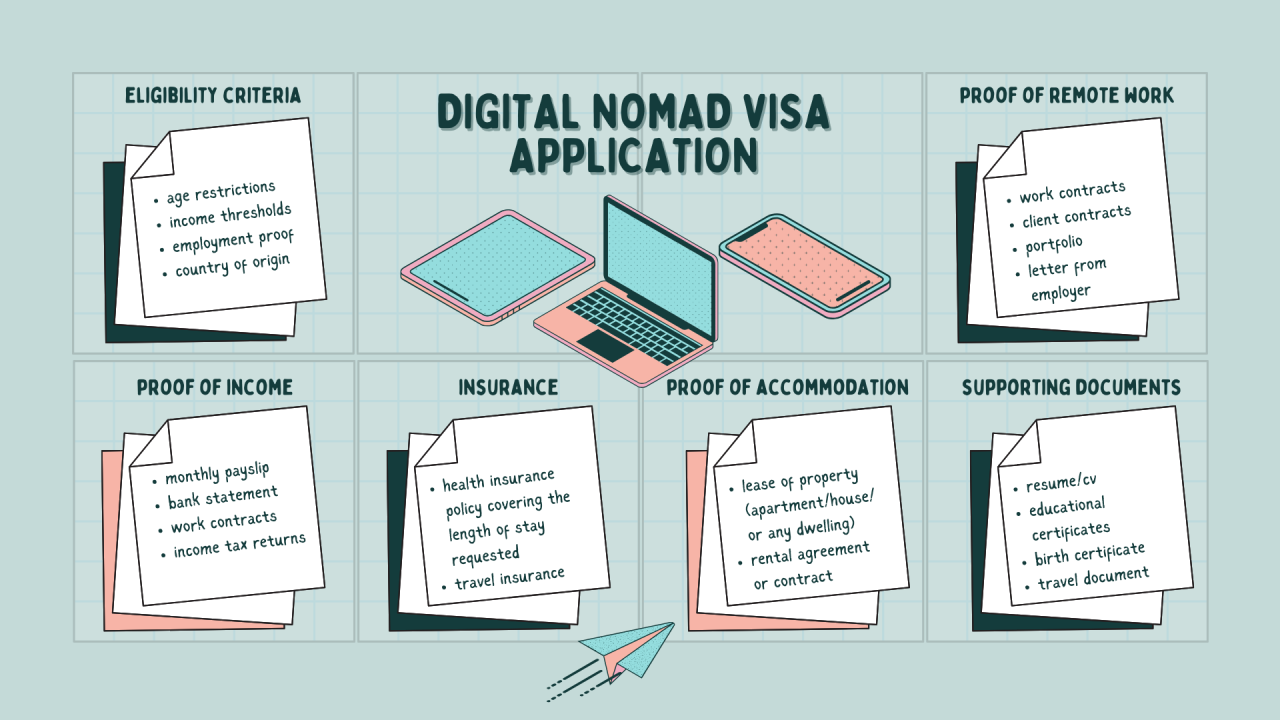
Portugal’s D8 file looks manageable until you list the parts that actually create delay:
- valid passport and core identity documents
- proof of remote work relationship
- proof of income at the threshold
- accommodation evidence
- criminal-record paperwork
- health insurance and related residence documentation
Accommodation is one of the big quiet problems. A lot of applicants assume they can use a casual short-term booking and sort the housing later. In practice, Portugal often rewards stronger residence logic than that. If your file looks like tourism with a laptop, it becomes much easier for the whole case to wobble.
Insurance is the quieter trap. Before you treat that line item as admin wallpaper, compare health insurance options for digital nomads against Portugal’s actual document expectations.
There is also a second issue people underweight: what the consulate accepts is not always the same thing as what later residence processing feels comfortable with. So even if your first-stage paperwork clears, a weak accommodation or banking setup can still make the follow-through messier than people expected.
What changed after Portugal’s tax-regime reforms
This is the part that keeps Portugal traffic high and advice quality low.
For years, a lot of Portugal nomad content sold one neat package: D8 visa plus NHR plus easy European lifestyle. That is not the right mental model anymore. Portugal’s old Non-Habitual Resident story has changed enough that applicants should stop treating it like an evergreen default benefit.
That does not mean Portugal stopped being attractive. It means the tax question now needs actual review instead of recycled nomad content.
If tax is one of your main reasons for choosing Portugal over Spain, Croatia, or Greece, treat that as a separate decision layer. Do not choose a residence route based on a tax regime you have not verified for your profile, your income source, and your likely tax residency timeline.
That is the blunt version, but it is the useful one.

Where AIMA becomes the real bottleneck
Portugal is still attractive on paper because the country itself is attractive on paper: EU access, strong nomad demand, familiar lifestyle appeal, and a route designed for remote earners.
The problem is that paperwork does not end at the consulate.
AIMA is now the key residence-processing institution in Portugal, and this is where a lot of D8 narratives get fuzzy. Applicants often learn the formal visa logic first and the operational queue reality second. That order should be reversed.
Portugal’s own public-service flow still reflects that reality. Residence-related service scheduling runs through AIMA channels rather than through some magical “nomad fast lane,” including online and phone booking routes for immigration service desks. [Portugal public service scheduling page] That is not proof that every D8 file will be slow. It is proof that the admin layer is real and should be planned for.
If you are choosing between Portugal and another country, ask yourself:
- Do I care more about Portugal specifically than about administrative simplicity?
- Am I comfortable with a heavier process if the country fit is strong enough?
- Is my file neat enough to survive a slower bureaucratic path?
Those are more useful questions than “Is Portugal the best digital nomad visa?” in the abstract.
Banking, tax residency timing, and the part Portugal applicants underestimate
Portugal attracts people who think one visa decision will solve three different problems at once: residence permission, tax optimization, and practical setup. Usually it does not.
The residence file is one lane. Your tax residency timeline is another. Your practical setup — NIF, bank account, lease quality, and proof that you can function as a real resident rather than a passing tourist — is a third lane. Applicants who keep those three lanes separate usually build stronger files.
This is also why Portugal punishes vague planning more than some competitors do. A country with strong nomad demand also tends to attract a lot of half-prepared applications. The cleaner your documentation and the clearer your reason for choosing Portugal specifically, the less likely you are to look like another person importing stale nomad advice from 2023.
Worth saying: Portugal still makes sense for a lot of people. The error is not choosing Portugal. The error is choosing it because of a recycled tax meme or because someone on YouTube made the D8 sound frictionless.
If you want the shortest path instead of the best country fit, Portugal will feel heavy. If you want a country you would actually use as a real base and you can document the income cleanly, it is still one of the more credible European routes.
When Portugal is still worth the paperwork
Portugal is still worth it if you want:
- an EU base with long-stay seriousness rather than visa-run logic
- a route designed around remote income instead of passive-income workaround framing
- a country you would actually want to use as a real base, not just a temporary stamp
Portugal is a weaker fit if:
- your income is inconsistent and hard to evidence
- your tax decision depends on outdated NHR assumptions
- you want the lowest-friction application rather than the strongest lifestyle fit
That is why Portugal remains a top-tier shortlist country without being an automatic winner.
And that is really the correct Portugal frame in 2026. Not “easy.” Not “dead.” Just strong enough to be worth the admin if the country itself is the prize.