Most digital nomad visa roundups tell you where the beaches are. They do not tell you the part that actually decides whether you can apply: the income bar.
That is the first real filter. Before lifestyle, before taxes, before coworking spaces, before all the YouTube thumbnails with scooters and laptops.
So I screened the current public list of remote-work and nomad-friendly routes and ranked them by the published financial threshold. The result is a lot less glamorous than the marketing copy. Some countries are genuinely accessible. Others are only "nomad friendly" if your income is already deep into upper-middle-class territory.
One thing that gets buried: the threshold number is only half of it. What the number is tied to matters just as much — a fixed dollar floor versus a formula indexed to local minimum wages are completely different things. More on that below.
Our Key Takeaways
- I screened 64 countries with active remote-work, freelancer, or digital-nomad-style routes and ended up with 49 comparable country entries.
- Of those 49, 44 publish a numeric threshold that can be roughly normalized into a monthly USD figure. 5 do not publish a clean public minimum.
- If you count only the lowest explicit digital-nomad-style programs with a published number, the current low-bar leaders are New Zealand, Albania, Ecuador, Colombia, and Mauritius.
- If you broaden the net to include passive-income or other remote-capable routes, Seychelles, Panama, and El Salvador sit even lower, but those are not the same thing as a classic digital nomad visa.
- The expensive end is not subtle. Iceland, Thailand's LTR route, Estonia, Japan, and Andorra all sit far above the "cheap nomad visa" crowd.
Methodology
This article uses the official government or official program page for each row in the final table.
Which criteria did I use to select the route for each country?
- I selected one remote-work-capable route per country, prioritizing a true digital nomad visa when one was published.
- If a country did not publish a clean digital nomad route with a number, I used the closest remote-capable public route that still appeared in the source set.
- I normalized published annual thresholds into rough USD per month estimates using exchange data from open.er-api.com at the time of writing.
- I kept bank-balance tests and no-public-minimum routes in the table, but flagged them because they are not directly comparable to a straight monthly income rule.
That matters, because "lowest bar" is easy to fake. A country can look cheap until you notice the threshold is tied to minimum wage updates, annual turnover, or a separate savings requirement.
Countries with Lowest Digital Nomad Visa Income Requirements
If you strip this down to the routes most people would actually shortlist first, the lowest published explicit digital nomad bars currently look like this:
| Option | Program | Core requirement | Approx. threshold / best fit | Note | Source |
|---|---|---|---|---|---|
| New Zealand | Visitor Visa (Remote Work / Digital Nomad) | NZD 1,000/mo, reduced to NZD 400 if accommodation is prepaid | ~$591 | Very low headline bar, but this behaves more like a visitor route than a classic long-stay nomad residence product | Official |
| Albania | Digital Mobile Worker (Unique Permit) | ALL 1,200,000/yr, roughly USD 9,800 total | ~$1,230 | Annual threshold, not monthly salary, which makes the headline easier to miss | Official |
| Ecuador | Visa Nómada | USD 1,446/mo, based on 3x the 2026 basic salary | ~$1,446 | Clear and relatively low, but dependent math pushes the real bar higher | Official |
| Colombia | Visa V Nómadas Digitales | COP 5,252,715/mo, tied to 3x the minimum wage | ~$1,467 | Looks accessible, but it is benchmark-linked and moves when local wage rules move | Official |
| Mauritius | Premium Visa | USD 1,500/mo per adult | ~$1,500 | Still one of the cleanest low-bar options if you want simple math instead of formula-chasing | Official |
That is the part most "cheapest digital nomad visa" content gets wrong. The genuinely low-bar options are not all conventional nomad visas, and some of the cheapest-looking routes are really passive-income or hybrid visitor frameworks.
If the low-bar end is your real market, the under-€2,000 nomad visa guide is the faster shortlist.
What Counts as a Low Income Requirement?
(For what it is worth: USD 1,500 per month is also roughly what a single person needs to live comfortably in most of the lower-bar countries on this list. The thresholds are not arbitrary.)
For this article, I treated anything under USD 1,500 per month as genuinely low, USD 1,500 to USD 3,000 as mid-range, and above USD 3,000 as meaningfully selective.
That split is crude. It is still useful.
A USD 1,500 bar is reachable for plenty of freelancers, agency operators, and mid-level remote employees. A USD 4,500 bar starts filtering for higher earners, couples with combined income, or people who already live in the better-paid corners of the remote economy.
And then there are the weird ones.
- Georgia looks moderate until you realize the public number is framed as annual turnover plus a subsistence-floor condition.
- Brazil looks easy at USD 1,500 per month, but some public guidance also allows a separate USD 18,000 bank-balance path.
- Thailand's better-known long-stay route is not low at all. The LTR threshold is expensive enough that it belongs in a different tier entirely, which is why the Thailand LTR visa breakdown belongs in a different planning bucket.
This is why a straight list of country names is not enough. The threshold type matters almost as much as the number itself.
The Countries With the Highest Bars
At the expensive end, the ranking gets crowded with countries that people love to talk about but fewer people can easily qualify for.
The current public high-bar group includes:
- Iceland at roughly USD 8,195/mo
- Thailand LTR at roughly USD 6,667/mo
- Estonia at roughly USD 5,310/mo
- Japan at roughly USD 5,245/mo
- Andorra at roughly USD 5,123/mo
That is a very different market than Ecuador or Colombia.
(To put Iceland in perspective: USD 8,195 per month is more than most software engineers in Western Europe take home after tax. The "digital nomad" label is doing a lot of work there.)
Side note: this is why "Europe has the best digital nomad visas" is only half-true. Europe has many of the cleanest programs. It also has many of the least forgiving thresholds.
Why these numbers keep changing
Most thresholds in this table are not fixed figures. They are formulas.
Colombia ties its bar to 3× the Colombian minimum wage. Ecuador uses 3× the Basic Unified Salary. Spain uses 200% of its minimum wage. Montenegro uses 3× its local minimum. When those base wages update — which they typically do annually — the digital nomad visa threshold updates automatically.
That matters for two reasons:
- Tables go stale. A threshold from early 2025 may already be wrong by mid-2026. Always verify against the official source in the month you plan to apply.
- "Getting in before the bar rises" is real. Countries with rapidly rising minimum wages (Montenegro is the sharpest recent example) are likely to get meaningfully more expensive over the next few years.
The safest way to read any benchmark-linked threshold: treat it as a floor estimate, build in a 10–15% buffer, and check the official page directly — not a third-party roundup — before you start the application.
That buffer matters even more when the consulate wants a documentary trail, which is where proving remote income for a digital nomad visa becomes part of the budgeting process rather than a separate admin chore.
The Full Comparison Table
Below is the full country-by-country comparison, sorted from the lowest published bar to the highest. Rows marked N/A either rely on a bank-balance structure that is not cleanly comparable or do not publish a public numeric minimum on the source page I reviewed.
| Option | Program | Core requirement | Approx. threshold / best fit | Note | Source |
|---|---|---|---|---|---|
| Seychelles | Residence Permit | SCR 100,000/yr · Must bring in foreign exchange equivalent to at least SR 100,000 annually through the Central Bank of Seychelles | ~$575 | Annual threshold converted to monthly | Official |
| New Zealand | Visitor Visa (Remote Work / Digital Nomad) | NZD 1,000/mo · per person; reduced to 400 NZD if accommodation is prepaid | ~$591 | Monthly income test | Official |
| Panama | Permiso de Residente Permanente en Calidad de Rentista Retirado | $850/mo · Must be generated exclusively from interest on a fixed-term deposit in a Panamanian state bank (Banco Nacional de Panamá or Caja de Ahorros) for a minimum of 5 years | ~$850 | Monthly income test; plus bank balance or savings evidence | Official |
| El Salvador | Residencia Temporal para Pensionados (F7) | $1,095/mo · Equivalent to 3x the national minimum wage (currently $365 USD); must be a lifetime pension from a foreign government or private institution. | ~$1,095 | Benchmark-linked threshold | Official |
| Albania | Digital Mobile Worker (Unique Permit) | ALL 1,200,000/yr · or equivalent in foreign currency (approx. $9,800); must be from foreign sources | ~$1,230 | Annual threshold converted to monthly | Official |
| Argentina | Residencia temporaria como rentista | ARS 1,789,000/mo · Equivalent to 5 times the Argentine Minimum Living and Mobile Wage (SMVM) | ~$1,312 | Monthly income test | Official |
| Ecuador | Concesión de visa de residencia temporal rentista para trabajo remoto (Visa Nómada) | $1,446/mo · Requirement is 3 times the Basic Unified Salary (SBU); $1,446 based on the 2026 SBU of $482. An additional $250 per month is required for each dependent. | ~$1,446 | Monthly income test | Official |
| Colombia | Visa V Nómadas Digitales | COP 5,252,715/mo · Equivalent to 3 times the Colombian minimum wage (SMMLV); must be demonstrated via bank statements from the last 3 months. | ~$1,467 | Benchmark-linked threshold | Official |
| Brazil | Digital Nomad Visa | $1,500/mo · or a bank balance of USD 18,000 | ~$1,500 | Monthly income test; plus bank balance or savings evidence | Official |
| Mauritius | Premium Visa | $1,500/mo · Minimum amount of USD 1,500 per month for each adult applicant and USD 500 per month for each dependent child | ~$1,500 | Monthly income test | Official |
| Georgia | Digital Nomad Visa | GEL 50,000/yr · Minimum annual business turnover of 50,000 GEL; additionally, personal monthly income must be at least 5 times the Georgian subsistence minimum (approx. 1,121 GEL). | ~$1,548 | Turnover/income threshold | Official |
| Montenegro | Long-stay visa (Visa D) for digital nomads | €1,350/mo · Requirement is 3x the minimum wage in Montenegro; while €1,350 was the initial threshold, recent minimum wage increases (to €600/€800) may raise this to €1,800–€2,400. | ~$1,593 | Benchmark-linked threshold | Official |
| Kenya | Class N: Digital Nomad Permit | $24,000/yr · Minimum assured annual income from sources outside Kenya; must be supported by 3 months of bank statements or payslips. | ~$2,000 | Annual threshold converted to monthly | Official |
| Malaysia | DE Rantau Nomad Pass | $24,000/yr · USD 24,000 for tech/digital roles; USD 60,000 for non-tech roles (e.g., management, legal, HR, finance) | ~$2,000 | Annual threshold converted to monthly | Official |
| Namibia | Namibia Digital Nomad Visa | $2,000/mo · USD 2,000 for main applicant; USD 1,000 for spouse; USD 500 per child | ~$2,000 | Monthly income test | Official |
| Sri Lanka | Digital Nomad Visa | $2,000/mo · Minimum monthly remittance of USD 2,000 for the main applicant (includes up to two dependents); an additional USD 500 per month is required for each dependent beyond the first two. | ~$2,000 | Monthly income test | Official |
| France | Entrepreneur / Profession Libérale (Self-employed person or liberal activity) | €21,876/yr · Equivalent to the French minimum wage (SMIC); €1,823.03 gross monthly as of January 2026 | ~$2,151 | Benchmark-linked threshold | Official |
| Armenia | Permanent Residence Status (Entrepreneurial Activity) | AMD 1,000,000 · Requires a business turnover of at least 1,000,000 AMD within the 60 days preceding the application or a balance of 1,000,000 AMD on business accounts; alternatively, a 2,000,000 AMD investment in charter capital for shareholders. | ~$2,671 | Turnover/income threshold | Official |
| Bulgaria | Digital Nomad Residence Permit (Art. 24ш) | €27,550/yr · Requires an average annual income for the previous calendar year of at least 50 times the Bulgarian minimum monthly wage (approx. €27,550 based on 2025 rates). | ~$2,709 | Annual threshold converted to monthly | Official |
| Italy | Digital Nomad / Remote Worker Visa | €28,000/yr · Requirement is 3x the minimum level for healthcare exemption; approximately €28,000 per year | ~$2,753 | Annual threshold converted to monthly | Official |
| Costa Rica | Estancia para Trabajadores y Prestadores Remotos de Servicios (Digital Nomad Visa) | $3,000/mo · or $4,000 for families; income must originate from outside Costa Rica | ~$3,000 | Monthly income test | Official |
| Kazakhstan | Neo Nomad Visa | $3,000/mo · Verified through bank statements for the last 6 months and a tax return from the country of citizenship | ~$3,000 | Monthly income test | Official |
| Turkey | Digital Nomad Visa | $3,000/mo · or 36,000 USD annually | ~$3,000 | Annual threshold converted to monthly | Official |
| Moldova | Digital Nomad Visa (Residence Permit for Digital Nomads) | MDL 52,200/mo · Equivalent to 3x the average monthly salary (17,400 MDL in 2026); must be proven for the 6 months prior to application | ~$3,053 | Monthly income test | Official |
| South Africa | Remote Work Visitor Visa | ZAR 650,976/yr · Gross annual income; must be proven by 3 months of bank statements | ~$3,314 | Annual threshold converted to monthly | Official |
| Czech Republic | Digital Nomad Visa | CZK 69,248/mo · 1.5 times the average gross annual salary in the Czech Republic (updated annually; current value for 2025-2026) | ~$3,355 | Benchmark-linked threshold | Official |
| Spain | Visado de residencia para teletrabajo de carácter internacional (Digital Nomad Visa) | €2,849/mo · 200% of the Spanish Minimum Wage (SMI); 2026 threshold is €2,849/month; additional for dependents | ~$3,362 | Benchmark-linked threshold | Official |
| United Arab Emirates | Virtual Work Residence Visa | $3,500/mo · or equivalent in foreign currency; applies to employees (business owners may require $5,000 in some jurisdictions like Dubai) | ~$3,500 | Monthly income test | Official |
| Hungary | White Card | €3,000/mo · Must be verified for the 6 months prior to application and maintained during the stay | ~$3,540 | Monthly income test | Official |
| Slovenia | Temporary residence permit for digital nomads | €3,200/mo · at least twice the average monthly net salary in Slovenia | ~$3,776 | Monthly income test | Official |
| Cyprus | Digital Nomad Visa | €3,500/mo · Net income after taxes and contributions; requirement increases by 20% for a spouse/partner and 15% per child | ~$4,130 | Monthly income test | Official |
| Malta | Nomad Residence Permit | €42,000/yr · Minimum gross annual income from remote work; investment income does not qualify | ~$4,130 | Annual threshold converted to monthly | Official |
| Serbia | Single Permit for an Independent Professional | €3,500/mo · 3,500 EUR is the specific threshold for digital nomads; general applicants must show means of subsistence (minimum salary). | ~$4,130 | Benchmark-linked threshold | Official |
| Croatia | Temporary stay of digital nomads | €3,622.5/mo · Equivalent to 2.5 times the average monthly net salary for the previous year; increased by 10% for each additional family member | ~$4,274 | Monthly income test | Official |
| Romania | Long-stay visa for digital nomads (D/AD) | €3,700/mo · at least 3 times the Romanian average gross monthly salary (approx. €3,700–€4,000 depending on the current average) | ~$4,366 | Benchmark-linked threshold | Official |
| Mexico | Visa de Residente Temporal (Solvencia Económica) | $4,393/mo · Requirement is based on multiples of the Mexican minimum wage and varies slightly by consulate and exchange rate; alternatively, savings of approx. $73,215 USD can be shown. | ~$4,393 | Benchmark-linked threshold | Official |
| South Korea | Workation (Digital Nomad) Visa (F-1-D) | KRW 85,000,000/yr · Must be at least twice the Gross National Income (GNI) per capita of the previous year as announced by the Bank of Korea (approx. $66,000 USD). | ~$4,801 | Benchmark-linked threshold | Official |
| Latvia | Long-stay visa for remote work | €4,213/mo · 2.5 times the average gross monthly salary in Latvia (currently €4,213) | ~$4,971 | Benchmark-linked threshold | Official |
| Indonesia | Remote Worker Visa (E33G) | $60,000/yr · Must be from a company registered outside Indonesia; also requires a bank balance of at least USD 2,000 for the last 3 months | ~$5,000 | Annual threshold converted to monthly; plus bank balance or savings evidence | Official |
| Andorra | D.3. Residència per a nòmada digital | €4,342/mo · 300% of the minimum wage for the main applicant; an additional 100% of the minimum wage is required for each dependent | ~$5,123 | Benchmark-linked threshold | Official |
| Japan | Specified visa: Designated activities (Digital Nomad, Spouse or Child of Digital Nomad) | JPY 10,000,000/yr · Must be from foreign sources; proof required via tax certificates, employment contracts, or bank statements showing the amount and contract period. | ~$5,245 | Annual threshold converted to monthly | Official |
| Estonia | Digital Nomad Visa | €4,500/mo · gross monthly income for the 6 months preceding the application | ~$5,310 | Monthly income test | Official |
| Thailand | LTR Visa (Long-Term Resident) | $80,000/yr · Minimum $80,000/year for the past 2 years; reduced to $40,000/year if holding a Master's degree, owning intellectual property, or receiving Series A funding | ~$6,667 | Annual threshold converted to monthly | Official |
| Iceland | Long-term visa for remote work | ISK 1,000,000/mo · Requirement is ISK 1,000,000 for a single applicant or ISK 1,300,000 if a spouse/partner is included; must be from foreign sources. | ~$8,195 | Monthly income test | Official |
| Austria | Residence Permit - Self-Employed | Not publicly specified | N/A | No public minimum published | Official |
| Germany | Residence permit for the purpose of freelance employment (Aufenthaltserlaubnis zur Ausübung einer freiberuflichen Tätigkeit) | Not publicly specified | N/A | No public minimum published | Official |
| Netherlands | Residence permit orientation year for highly educated persons | Not publicly specified | N/A | No public minimum published | Official |
| Norway | Self-employed persons with a company abroad | Not publicly specified | N/A | No public minimum published | Official |
| Uruguay | Hoja de Identidad Provisoria Nómada Digital | Not publicly specified | N/A | No public minimum published | Official |
What This Table Does Not Mean
A low threshold does not automatically mean a country is the easiest, fastest, or cheapest place to base yourself.
It only means the published financial bar is lower.
You still have to care about:
- whether the route is a real digital nomad visa or a looser passive-income workaround
- whether the program uses gross income, net income, turnover, or remittance language
- whether dependents push the number up sharply
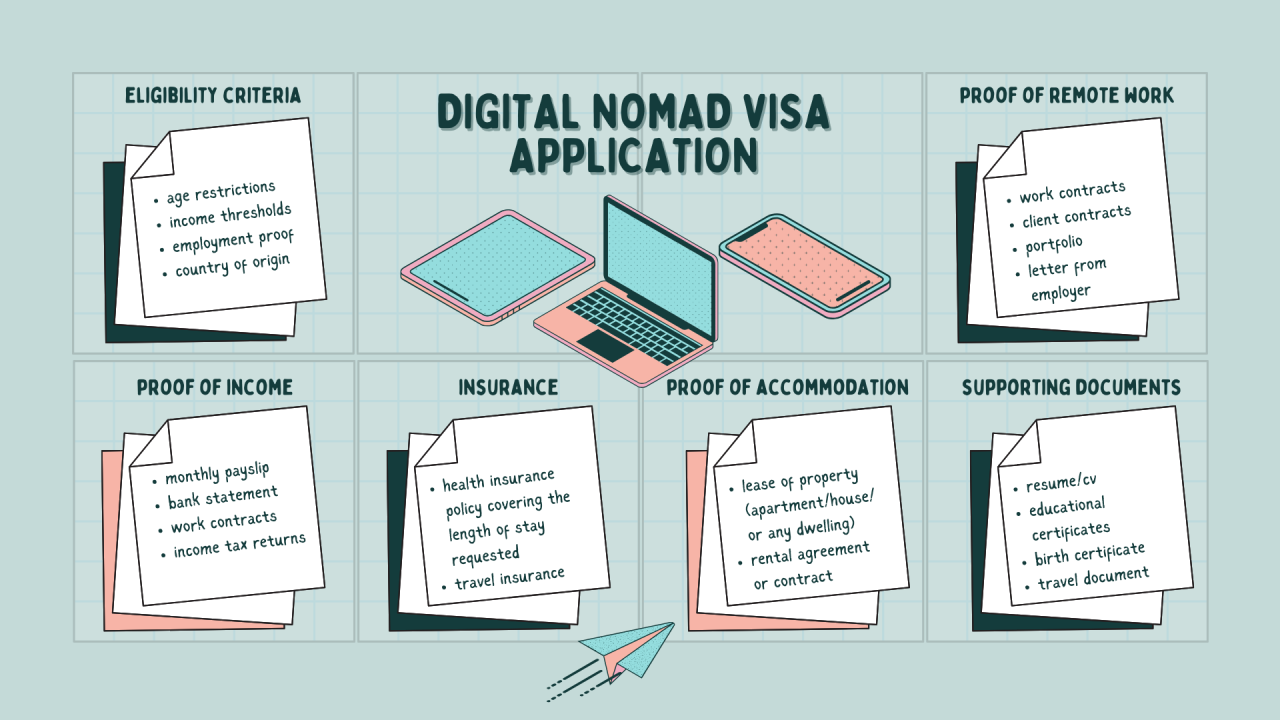
- whether the country also expects insurance, apostilles, criminal-record certificates, or local registration after arrival
That last part is where the "cheap nomad visa" fantasy usually falls apart. And if you are still looking at tourist status as the fallback option while you figure this out, that carries its own legal risks that a favorable income threshold cannot solve.
Insurance can quietly do the same thing to an otherwise viable application, so best health insurance for digital nomads is worth reviewing alongside the threshold math, not after it.
The Practical Read
If you want the lowest public number without too much legal ambiguity, Albania, Ecuador, Colombia, and Mauritius are the names that stand out most cleanly.
If you want Europe specifically, the cheaper end is still not all that cheap. Albania is the obvious outlier. After that, the continent climbs fast.
If you are comparing popular headline destinations, the bar is much steeper than social media makes it look. Spain’s digital nomad visa and Croatia’s digital nomad visa are useful examples because both look straightforward until the proof and funds requirements show up in full.
Estonia belongs in the same high-bar conversation too, which is exactly why the Estonia digital nomad visa guide only makes sense if the administrative clarity is worth paying for.
And if a country does not publish a clear minimum at all, treat that as bureaucracy risk, not flexibility. Sometimes "no public threshold" really means "you are about to discover the actual rule in an email chain with a consulate."